Contents
- Introduction
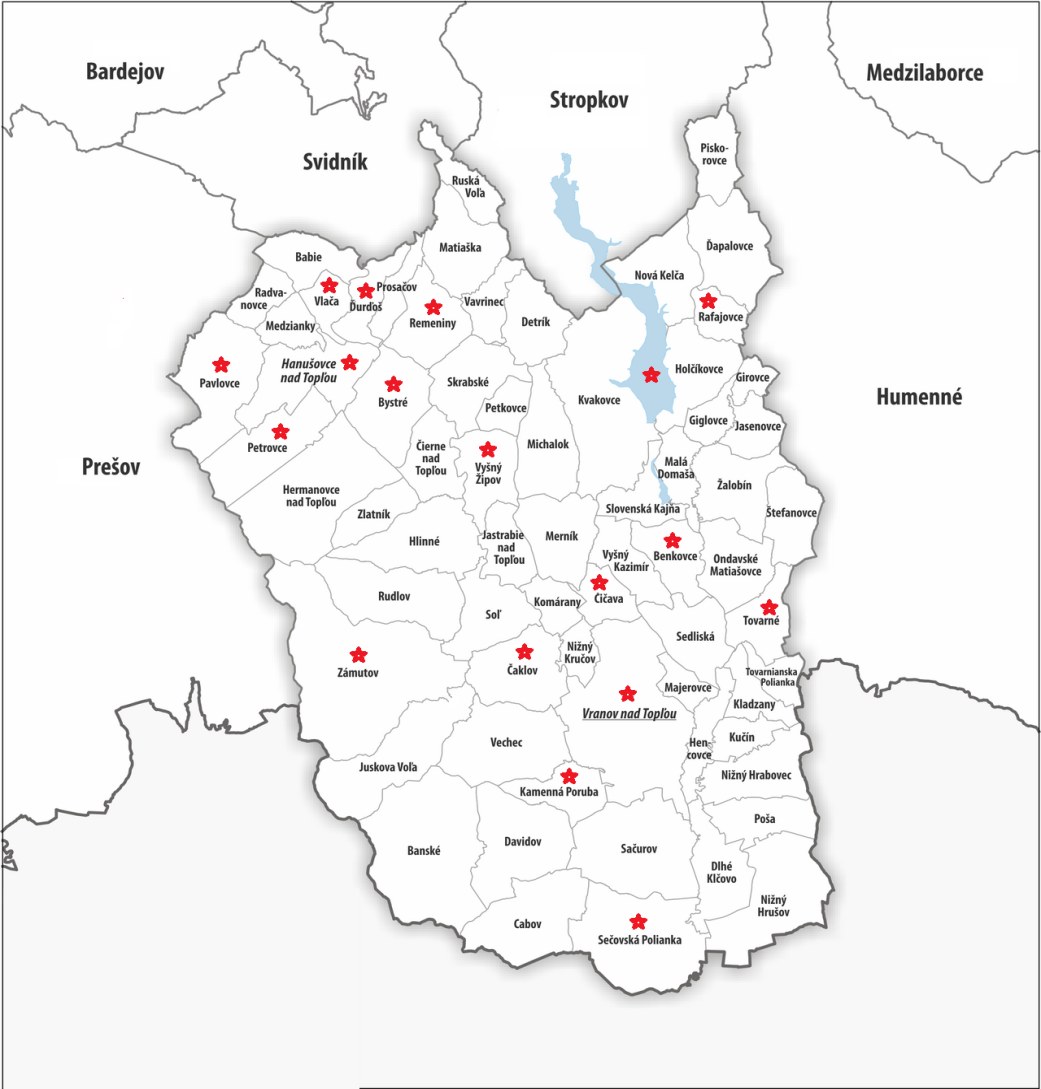
- The Vranov nad Topľou district – a geographical view
- Cultural centres of the Vranov nad Topľou district, musical and traditional folk culture
- Cultural centre of the Zemplín part – the town of Vranov nad Topľou
- Cultural centre of the Šariš part – the town of Hanušovce nad Topľou
- Folk ensembles in the Vranov nad Topľou district
- Bukovčan folk ensemble
- Vranovčan folk ensemble, town of Vranov nad Topľou
- Bystrančan (Cementár) folk ensemble, village of Bystré
- Oblík folk ensemble, town of Hanušovce nad Topľou
- Playing occasions for bands in the second half of the 20th century
- Weddings – veśeľa
- Village dances – Pri hudakoch (“at the musicians”)
- Tradition bearers of folk culture in the Vranov district
- Michal Varga from Petrovce
- Andrej Velčko from Petrovce
- Mikuláš Vasiľ from Poša
- Ján Šarišský from Remeniny
- Juraj Šaffa from Dlhé Klčovo
- Folk bands in the Vranov nad Topľou district
- Bands of the Šariš part of the district
- The band of Ján Saukulič from Bystré
- The Mitráš family band from Bystré
- The Baláž family band from Remeniny
- The band of Ján Husák Rabčák from Ďurďoš
- The band of Juraj Husák from Ďurďoš
- Bands from the village of Vlača
- The Jančár family band from Pavlovce
- The band of Andrej Čurlík from Petrovce
- The band of Ernest Haluška from Hanušovce nad Topľou
- The band of Ladislav Lacko from Hanušovce nad Topľou
- The band of Ján Kiňa from Hanušovce nad Topľou
- The band of Michal Horvát from Hanušovce nad Topľou
- Bands of the Zemplín part of the district
- The band from Čaklov
- The band of Belomír Rigo from Čaklov
- The Kura family band from Vyšný Žipov
- The band of Jozef Feri Jusko from Zámutov
- The Mucha family band from Kamenná Poruba
- The band of Jozef Vasiľ Miko from Sečovská Polianka
- The bands from Čičava
- The band of Ján Miškovič from Tovarné
- The band of Ján Kukuš from Benkovce
- The Tomáš family band from Dobrá nad Ondavou
- The band of Michal Michalov from Rafajovce
- Conclusion
Introduction
For years I have been active in traditional folk culture as a performer of traditional music, and I have come to feel that the importance of folk music is being pushed into the background. Usually it does not matter which band plays or how it plays, as long as somebody accompanies the dancers. The wider cultural public surely knows well-known dancers, choreographers and singers better, while musicians are somehow forgotten. Yet it is precisely the musicians who were, and still are, an important link in traditional culture, contributing considerably to its preservation and spread. Generations of musicians gradually passed on their musical knowledge as well as the local repertoire, mainly so that they could play at weddings and dances. Without them we would know today only a fraction of the rich musical material that we can present now. That is why I decided to take a closer look at least at part of the area I come from and where I grew up as a musician. My aim was to document and describe the folk bands that were active here in the second half of the 20th century. I was finally able to turn many years of private interest in traditional folk music and old bands into a larger, publicly available and freely shareable project. I am grateful that this idea was financially supported by the Slovak Arts Council (Fond na podporu umenia, 2025) and by the Fund for the Support of the Culture of National Minorities (Kult Minor, 2026). Many thanks also go to the informants, village mayors and leaders of folk ensembles, who were willing to cooperate and knew how to point me in the right direction.
I carried out 18 field research visits in 11 villages of the Šariš part of the Vranov nad Topľou district (2025) and 15 field research visits in 10 villages of the Zemplín part (2026). I visited the archives of all institutions that have documented traditional culture in Slovakia in the past, as well as village archives and other cultural institutions. The outcome of my documentary research is this multimedia document, which describes in more detail the folk string bands active in the Vranov nad Topľou district.
I believe that this documentary research will give everyone who reads it a clear picture of the bands, of what weddings and village dances once looked like, and of what a musician’s life used to be. The research is perhaps presented a little unconventionally, but I did not want to leave out the funny musicians’ stories that were surely part of everyday life.
Radoslav Kertis
The Vranov nad Topľou district – a geographical view
The Vranov nad Topľou district is one of the districts of the Prešov Self-Governing Region. It covers 769.47 km2 and has a little over 79,000 inhabitants. There are 68 municipalities in the district, two of which have town status – Vranov nad Topľou and Hanušovce nad Topľou. The terrain is varied: the East Slovak Lowland reaches into it from the south, it is bordered by the Slanské vrchy hills in the west and by the Low Beskids in the north. Two rivers flow through it, the Topľa and the Ondava. The population is predominantly Slovak; only in the northern part, bordering the Svidník district, lives a small number of Rusyns. There is also a sizeable Roma population.
Historically, the district lies in the territory of two counties – Šariš and Zemplín. The county border runs from Oblík hill along the Hermanovský brook, which flows through the villages of Hermanovce and Bystré and then into the Topľa river, and continues towards Giraltovce, Stropkov and the Lupkov Pass. The village of Bystré itself is therefore divided into a Zemplín and a Šariš part. Until 1882 the village was split into two separate parts. [1]
Cultural centres of the Vranov nad Topľou district, musical and traditional folk culture
From the point of view of traditional folk culture, the Vranov nad Topľou district extends over two rich regions of Slovakia, and the folklore of Šariš and Zemplín mixes here in a very interesting way. While the Zemplín part is characterised, in terms of dance, by women’s round dances, karička circle dances, men’s cifrovanie, čapáš, čardáš and other couple dances, the Šariš part adds to these the krucená, verbunk, ceperki, the dances sólomaďar and čerjana, and various types of polka (Hanušovce, Raslavice, Šemetovce, Hertník and Mirošov polkas). These dances were, of course, accompanied by music, and the bands in the area had a very rich range of tunes in their repertoire.
Cultural centre of the Zemplín part – the town of Vranov nad Topľou
The cultural centre of the Zemplín part of the district is the town of Vranov nad Topľou. The first written record of the town dates from 1270, when the estate was owned by the Rozgonyi family. In the second half of the 15th century a fortified water castle was built in the town. During the Hungarian–Polish fighting of 1491–1492 the castle was damaged and later rebuilt as a Renaissance manor house. An important trade route to Poland ran through the town, so it became a significant settlement with the right to collect tolls. A notable event in the town’s history was the wedding of Elizabeth Báthory, later the Lady of Čachtice, and Ferenc Nádasdy in 1575, attended by some 4,500 of the most prominent nobles from all over the Kingdom of Hungary.
In 1778 a strong earthquake destroyed the remains of the fortifications and the water castle, from which the Forgách family then built a manor house. In 1831 Vranov nad Topľou and its surroundings became the centre of the East Slovak peasant uprising. The insurgents looted the houses of the gentry and Jewish shops in the town, and did not spare the manor house either. From the beginning of the 19th century the town declined economically, but it nevertheless remained an important cultural and political centre of Zemplín County and became the seat of the district. [14][15][16]
Cultural centre of the Šariš part – the town of Hanušovce nad Topľou
A more interesting town, at least from a cultural point of view, was Hanušovce nad Topľou, which can be regarded as the cultural centre of the Šariš part of the district. Culturally and historically the town is dominated by a Baroque manor house built in the first half of the 18th century. Its owners were the noble brothers Tamás and József Dessewffy.[2]
Samuel Bruss (former deputy director of the Regional Museum in Prešov and administrator of the Hanušovce manor house, personally authorised by the descendants of the Dessewffy family to act officially on their behalf) spoke about the close relationship of the manor’s owners to music. According to him, József’s grandson, František Dessewffy Jr. (*1754 – †1820), was very musically gifted. He played actively, composed music and maintained a court orchestra at the Hanušovce manor. František was on very friendly terms with the noble Brunsvik family of Dolná Krupá, through whom he personally met Ludwig van Beethoven (*1770 – †1827) and subsequently invited him to Šariš. It is said that Beethoven even worked a Šariš polka tune into one of his symphonies. František had no descendants. After his death in 1820 the whole collection of music and scores was moved to the manor in Fintice, seat of the younger comital branch of the Dessewffys. In 1945, after the Russian front had passed, the whole collection came into the hands of an educated teacher from Fintice, Jozef Kolarčík Fintický, who then handed it over to the National Library in Martin. Today it is the most important collection of music manuscripts and prints in Slovakia. Its long-term study and description is the work of Assoc. Prof. Renáta Kočišová, PhD., of the Department of Music, Institute of Music and Fine Arts, Faculty of Arts, University of Prešov.1
All of this certainly influenced the musical feeling and thinking of the people in the surrounding villages. Folk bands from nearby villages often played on Sundays in the manor park, entertaining the local people as well as the count’s family. Musical culture therefore has very deep roots here. Personally, I consider this area exceptional in the number and quality of its village bands.
Folk ensembles in the Vranov nad Topľou district
In preserving and spreading traditional folk culture, the Vranov nad Topľou district has long been one of the most developed and active districts in Slovakia. The names of many of its villages are familiar to the wider public as attractive and well known in connection with folklore. We must mention excellent dancers: Juraj Šaffa from Dlhé Klčovo, Mikuláš Vasiľ from Poša, Štefan Višňovský from Zámutov, Jozef Vasiľ and Michal Hirko from Sečovská Polianka; singers: Michal Varga from Petrovce, Jozef Výrostko, Ján Ďorďovič and Vasiľ Iľov from Zámutov, Ján Dravecký from Čaklov, Ján Šarišský and Mária Hrehová from Bystré, Peter Kocák and the Ťasko siblings from Vranov nad Topľou; as well as well-known musicians: Ján Horvát Jančar from Pavlovce, Jozef Feri Jusko, Jozef Kroka Češľak and Juraj Ovšák from Zámutov, Ján Husák Rabčák and Juraj Husák from Ďurďoš, Michal Dávid Tulo and Ján Saukulič from Bystré, Ján Kukuš from Benkovce; and experts in traditional folk culture: Jozef Švarbalík, Štefan Kocák and Peter Kocák, all of whom come from this area.
In the second half of the 20th century almost every larger village in the district had a folk group or folk ensemble, and many still have one today. The first folk ensemble in the district was a youth ensemble founded at the Secondary Agricultural Technical School in Čaklov. It was established in 1952 by Mrs Helena Vrbová.[3]
The folk groups were mostly purely singing groups presenting local folklore that did not reach beyond the district. Musical accompaniment was often missing; later, in the 1980s, it usually consisted of just an accordion. Exceptions were the Zámutovčan folk group from Zámutov, where an excellent band led by Jozef Feri Jusko and Jozef Kroka Češľak played for many years, and the folk group from Čaklov, which was accompanied by a cimbalom band.
In the 1950s and 1960s there was an effort in the district to present folklore at a higher level, with a broader focus and reach. Several folk ensembles were founded as a result. In Vranov nad Topľou the Domovina ensemble (later Vranovčan) was established, and the Bukovčan ensemble at the Bukóza works in Hencovce. In the Šariš part of the district these were the Cementár ensemble (later Bystrančan) in Bystré and the Oblík ensemble in Hanušovce nad Topľou. These ensembles brought together not only dancers and singers but also musicians from the surrounding area, giving rise to the bands that are the subject of this research project.[1]
Bukovčan folk ensemble
In 1948 a major wood-processing and chemical plant, Bukóza, was founded in Hencovce near Vranov nad Topľou. Many employees from the nearby and wider surroundings of Vranov found cultural activities through the plant’s club. On its initiative several youth clubs developed, the most successful being the Bukovčan music, singing and dance club (later the Bukovčan folk ensemble), founded in 1957.
Its first performances were at special occasions, company celebrations and state holidays. The ensemble developed artistically very quickly, thanks above all to its leading figures. The post of leader was held in turn by Mr Roth, Hlaváč, Dziak, Sedlár, Cibira, Kožíková and others. The ensemble’s performances gradually expanded from local regional celebrations and festivals to the whole of Slovakia and to the countries of the former Soviet Union; it also visited Germany and France. It appeared in the television programmes of the time such as Sami sebe, Parabola Dubník, Nedeľa v klube and Víťazná cesta.
The long-standing artistic director was Jozef Hlaváč, a former member of Lúčnica, and the band was led by the primáš (lead violinist) Ľudovít Oláh. The band consisted of violin, viola, double bass, cimbalom and clarinet. Its members were Ľ. Oláh, J. Balog Sr., J. Balog Jr., M. Balog, Mr Ďurko Sr. and S. Ďurko. The repertoire was based mainly on stylised dance and music of Upper Zemplín. Several choreographers worked with the ensemble over time: Jozef Bakšay, Jozef Hlaváč, Ján Sabol and Štefan Kocák. The ensemble ended its activity in the summer of 1993. Many of its members continued their hobby in the Vranovčan ensemble and other folk groups.
Vranovčan folk ensemble, town of Vranov nad Topľou
The beginnings of the Vranovčan ensemble go back to 1968, when the local choir was revived. It joined with people interested in folk dance and song, and on 1 October 1968 the song and dance ensemble DOMOVINA was founded. Its founding body was the House of Culture and Education in Vranov nad Topľou. Its members were mainly school teachers, students and working young people. The ensemble first appeared in public on 6 November 1969 at the celebrations of the 52nd anniversary of the October Revolution in Vranov nad Topľou. The primáš of the first band was Aladár Balog.[12]
The present form, character and style of the ensemble began to take shape in 1971, when Michal Fečko – former head of the primary school in Komárany, an ardent lover of folk art, folklorist, teacher and excellent organiser – took over its management. In the autumn of 1971 the choreographer and artistic director Ing. Jozef Kamas left the ensemble, together with most of the dancers, and the band also broke up. On 1 October 1971 Štefan Kocák became choreographer and artistic director. He began researching folklore material in the villages of the district and used his findings in creating choreographies. On 1 June 1972 DOMOVINA was divided into two independent groups: the teachers’ choir kept the name DOMOVINA, while the dance and music sections, together with a newly auditioned girls’ singing group, continued under the new name VRANOVČAN. Štefan Kocák led the ensemble artistically until 2002, when he was succeeded by his son Peter Kocák. Under Peter Kocák the ensemble began preparing full-length thematic programmes with great emphasis on preserving original dance, singing and musical expression. Vranovčan has become one of the most respected folk ensembles in Slovakia. [12]
Over the years several bands played in the ensemble. When it was founded the band consisted of: Aladár Balog Jr. – primáš, Andrej Kulík and Ján Račko Sr. – violins, Jozef Mičko – viola, Aladár Balog Sr. – cimbalom, Ľubomír Varínsky – double bass. After primáš Aladár Balog Jr. left (1971), the band was taken over by Jozef Šamo (1971 – 1974), then by Imrich Adam and, for a short time, by Jozef Kroka Češľak. The long-standing primáš was Mgr. Marián Magda, who led the band from 1974 to 1997. Other primášes were Ing. Ľubomír Gális, Ing. Ján Dravecký (1998 – 2008) and Mgr. Ondrej Šinaj (2008 – present). [12]
Bystrančan (Cementár) folk ensemble, village of Bystré
The Bystrančan folk ensemble, formerly Cementár, was founded in the second half of 1954 in the village of Bystré in the Vranov nad Topľou district, where it is still active. It was established by the works group of the Czechoslovak Youth Union at the Bystré cement works. Its first public performance took place in 1955 at the opening of the cement plant in Bystré. The rich cultural programme then included the folk ensemble performing the dance “Šariš karička”, accompanied by a Gypsy band led by Michal Dávid Tulo. The first choreographer and leader of the ensemble was Helena Dziváková. The ensemble progressed and took part in various performances and festivals throughout the country and abroad. Over the years several primášes and bands played with it.
The first primáš was Michal Dávid Tulo from Bystré, followed by Ján Saukulič, also from Bystré, and Bartolomej Kura from Vyšný Žipov. The ensemble was led in turn by Ján Saukulič, Pavol Smik, Jozef Krajňák, Anna Liptáková, Pavol Baran, Andrej Hreha and Andrej Sabo. [4]
In 1993 the municipal office in Bystré became the founding body of the Cementár ensemble and it was renamed Bystrančan. The band was led until 2007 by Juraj Husák from Ďurďoš, later by primáš Radoslav Kertis from Čičava and today by Eduard Tokár from Strážske. The ensemble presents the folklore of the Šariš and Zemplín regions. Its current artistic director is Martin Haľko from Bystré. [5]
Oblík folk ensemble, town of Hanušovce nad Topľou
The original group of young people began to form in 1967 in the village of Petrovce under the leadership of Andrej Velčko, an enthusiast for traditional folk culture, and Michal Varga, a tradition bearer, singer and dancer. The name Oblík is the same as that of the hill in the Slanské vrchy rising above the village. After two years in Petrovce, Andrej Velčko got a job at the Cultural Centre in Hanušovce nad Topľou and the ensemble moved to that small town, growing with young people from Hanušovce. Andrej Velčko drew ideas for the repertoire from local sources and from distinctive villages of Šariš and Zemplín, where he collected material himself. The ensemble won awards in various competitions and was very highly rated. It performed at prestigious festivals across the country (Východná, Strážnice, Svidník and others). In 1972 Slovak Television made the documentary A na našim moscičku with Oblík, capturing a traditional village dance with a band.
To manage the change of generations, Andrej Velčko founded the children’s ensemble Topľan in 1971, where he trained young members. After only three months it won first place in the district competition. Topľan’s further successes inspired the editor Peter Kasalovský to write the screenplay for the film Deti spod Oblíka (Children from beneath Oblík), shot together with Oblík in 1974. Oblík also shone in the television dance competition V znamení trojky, which aimed to support artistic creativity. Under Andrej Velčko’s leadership Oblík matured technically and became known to the Slovak cultural public. Oblík also produced dancers who turned occasional dancing into a profession: Ján Tešinský and Andrej Sabó became members of the Slovak State Folk Ensemble (SĽUK), and the dancer Helena Lipčáková, née Sabová, performed in the Prešov-based Podduklianský folk ensemble (PUĽS). After Andrej Velčko’s illness and retirement on disability pension, the ensemble noticeably declined and for a time stopped its activity. The children’s ensemble Topľan ceased to exist entirely in the mid-1980s. [1] With shorter breaks, Oblík has survived to this day. Its current artistic director is Jaroslav Mucha.
Besides excellent dancers and singers, the ensemble also brought together several outstanding musicians and bands from the area. At the very beginning it was a band with primáš Andrej Čurlík, which, however, never performed with the ensemble. It was replaced by the Jančár family band from Pavlovce, which accompanied the ensemble only a few times. The first more stable band was led by Ladislav Lacko, later by Ján Saukulič, Ján Husák Rabčák and finally Juraj Husák. Juraj was Oblík’s primáš for many years. [6]
Playing occasions for bands in the second half of the 20th century
Folk bands were an inseparable part of village life. They brought villagers entertainment, which was in great demand after hard everyday work. The most frequent playing occasions were village dances, weddings, May festivals (majáles), church fair (odpust) celebrations and various other social events. During my fieldwork I asked informants how these events went, when they took place and what social rules applied.
The main informants were primáš Juraj Husák (*1947–†2022, Ďurďoš), my grandfather Michal Kertis (*1927–†2025, Vranovské Dlhé), Anna Hricová, née Janočková (*1927, Čičava), Ján Šarišský (*1944–†2025, Remeniny) and Koloman Kukuš (*1947, Benkovce). The informants were chosen deliberately to offer different perspectives on these events (that of a musician, a parobok – a young unmarried man, a dzivka – a young unmarried woman, and a singer – a culturally very active person). In this way I gained a clear picture of what a village dance or wedding used to be like.
Weddings – veśeľa
“The wedding has long been, and still is, one of the greatest social events in the village. It was the richest complex of varied rites and customs of all family customs, and it has been preserved the most up to the present day. In the past it was held at a quiet time in the farming year, most often during Carnival (fašiangy) or in autumn before Advent – that is, when there was more food in the household with which a wedding feast could be provided with dignity. Until the First World War a wedding among wealthier farmers lasted a whole week; later it was reduced to three days.” [7 s.34]
Until the 1960s weddings were usually held in the homes of the newlyweds, later in tents set up in the groom’s yard and in village culture houses. Thanks to the great age of my informants I was able to obtain information from the time when weddings still took place in family houses, which is very valuable.
Preparing for a wedding included, among other things, securing musicians to entertain the guests. Every prospective bridegroom first assessed his finances and then approached the band of his choice.
„Tu na Dluhe chodziľi na veśeľa muzikanci z Čemernoho (teraz mestská časť Vranova nad Topľou) z Čičavi, kus lacňejše.“
“Here in Dlhé, the musicians who came to play at weddings were either from Čemerné (now part of Vranov nad Topľou) or from Čičava – they were a bit cheaper.”
Michal Kertis
Well in advance, the young groom met the primáš of the chosen band and they agreed on the date of the wedding and on the musicians’ pay. Once agreed, the primáš left his violin with the groom as a deposit. Later on, primášes even left their identity cards as a deposit. If the musicians were from the same village and there was trust between the groom and the primáš, no deposit was given. The young man did not pay any money in advance. A designated person, usually the older best man (starší družba), arranged the musicians’ transport to the wedding and back.
At the turn of the 19th and 20th centuries a wedding among wealthier farmers could last a week; later it was reduced to three days, and after the Second World War to one day.
The wedding officially began on Monday. On the Sunday before, the bride went to church with her bridesmaids; after Mass all the bridesmaids went to the bride’s house, where lunch was waiting. They sang and bade farewell to the bride and her freedom. Then they moved to the groom’s house, where there was dancing to the band until late in the evening. On Monday the wedding began both at the bride’s and at the groom’s home, with the band playing from the morning. On arrival, the primáš wished everyone good morning and played a halgató (a slow, free-rhythm song), followed immediately by a fast čardáš so that the day would start merrily. The best men began to arrive, sat down and ordered songs of their own choice. On Monday morning the guests went to the groom’s house and from there, in a wedding procession with the band playing, to the bride. They went to ask for her hand – odpitac. At the head of the procession always walked the standard-bearer – maršavka – carrying a young birch or spruce decorated with white ribbons. Together with the bride, the whole procession then went on to church for the wedding ceremony – priśaha. From church the procession first went to the bride’s house, where they feasted and celebrated, and then moved to the groom’s house, where the wedding party continued until morning. If the wedding took place within one village, the guests walked; if they came from other villages, they travelled on horse-drawn carts. “The carts and horse teams were decorated with embroidered towels, paper roses and crepe-paper ribbons.”[7 s.58]
In the yard, at the front door of the groom’s house, the procession was welcomed by his mother – svadbena mac – who blessed them and invited everyone to the feast. If the weather allowed, the feast and celebrations took place outside in the yard; if not, they celebrated indoors. The small homes of the time did not offer much space, so dancing and merrymaking indoors were rather limited. Squeezing the wedding guests and the musicians with all their instruments into small rooms was a problem.
„To maľi i cimbali, ta večšinu daľi do zadňej chiži a otvoriľi a tak hraľi, bo bi śe ňepomejsciľi.“
“If they had a cimbalom too, they usually put it in the back room, opened the door and played like that, because otherwise they wouldn’t have fitted in.”
Michal Kertis
„Śicke nabitki s chiži muśeľi vonka do pľevni viscahovac, abi dnuka pomejsciľi.“
“All the furniture had to be carried out of the room into the barn so that we could fit inside.”
Koloman Kukuš
In an interview, primáš Juraj Husák from Ďurďoš recalled playing at wedding feasts. According to him, playing at weddings was very demanding, and playing at the tables for three hours without a break was not unusual. He also remembered the cramped spaces in family houses.
„A chceľi tancovac, ta i stolami ciskali. i jedzeňe nośiľi, či poľivku či guľaš, ta to śi śe tak uhiňal, ce ňeoľali. A , uš stani a ňeskorši kulturaki, ta to uš voľno.“
“And when they wanted to dance, we squeezed in between the tables too. And when they were carrying food, soup or goulash, you were constantly dodging so they wouldn’t spill it on you. Later, when there were tents and then culture houses, there was plenty of room.”
Juraj Husák
If the house had no room at all for playing indoors, the wedding party usually moved out into the yard.
„Ras pametam, že vonka, hrac a tancovac śe tam ňedalo a bula maľučka, ta vźali cimbali, basi a śe presunuľi do karčmi a tam bula .“
“I remember once it was very nasty outside, you couldn’t play or dance out there, and the room was tiny, so they took the cimbaloms and basses and everybody moved to the pub, and the wedding party was held there.”
Anna Hricová
At the wedding feast the musicians played dance rounds. Each dance round – tanečne solo – usually began with a waltz, followed by a polka, the krucená (only in the Šariš part of the district), a čardáš and, later, a tango as well. During my research I also came across the information that a round began with a čardáš and ended with a waltz; this was rare and happened when one of the young men ordered a čardáš at the start of the round. The length of the rounds depended on who was present. The utopian idea that every young man and woman could dance well vanishes with these words:
„To sebe ňedumaj, že každi znal tancovac. tri, śtiri pari tancovaľia ostatňe śedzeľi za stolami.“
“Don’t think that everybody could dance. Sometimes only three or four couples danced and the rest sat at the tables.”
Anna Hricová
The musicians played a sequence of songs of their own choosing. It was not customary to order songs during a dance round at a wedding; anyone who wanted to order a song usually did so before the round started. During the musicians’ break the girls and married women danced karička circle dances – u koľeśe – and the men drank and sang parobske (young men’s) songs. During the break the musicians were seated at a table and served dinner.
The party went on late into the evening. Before midnight the young married women, the svatki and the older best man took the bride into the next room or to the neighbours to začepiť her – to put on the married woman’s cap. They symbolically removed the parta, the bridal wreath (a symbol of virginity), put a cap on her head and tied a headscarf – chustka (a symbol of a married woman). The capping was the task of two married women – the svatki – and always took place in another room without the guests. When the capped bride was brought back, the redovi dance began, opened by the older best man and closed by the groom. Every guest who wanted to dance with the bride had to pay first, and the money collected was finally given to the newlyweds. The party continued into the early morning hours until the master of ceremonies (starejší) ended it and ordered the musicians to play the farewell march – viprovadzana. The musicians were paid after the wedding. The money was always given to the primáš, who then divided it among the other members of the band. In the 1960s the usual fee was around 500 Kčs for the whole band.
„A to peňeźi, bo mi chodzil cali meśac zbirac cukrovku (cukrovú repu) na , ta mi dali 120 Kčs.“
“And that was a lot of money, because when I went to pick sugar beet at the cooperative for a whole month, they gave me 120 Kčs.”
Michal Kertis
The musicians could earn something extra by playing requests between the tables.
Village dances – Pri hudakoch (“at the musicians”)
The second most frequent playing occasion for musicians, and a chance for villagers to enjoy themselves, were village dances – pri hudakoch, na muzike. They were held on Sunday afternoons. Dances in neighbouring villages were arranged in advance so that two nearby villages would not hold one on the same day; villages often took turns organising them.
„ cigaňi same ot sebe začali na ciganskej osadze a tak vnadzili parobkoch, bula zabava.“
“Sometimes the Gypsies started playing on their own in the Roma settlement, and that lured the young men into holding a dance.”
Anna Hricová
A dance was preceded by booking the musicians, much as for a wedding. The musicians were booked – pojednaľi – by the young men, who pooled money for the fee in advance. Dances were most often held outdoors, in an open space, under a big tree, on a meadow – wherever there was a larger flat area. In bad weather they took place in pubs, barns and later in culture houses. An entrance fee was collected.
„Dzivki a starše ľudze placiľi po tri koruni a parobci po . śe dajakomu parobkovi bačila , ta zaplacil i za ňu.“
“The girls and older people paid three crowns each and the young men five. If a young man fancied some girl, he paid for her too.”
Michal Kertis
The young men who organised a dance also bore some risk that they would not get back the money they had paid the musicians, but this happened only occasionally. There was always great interest in village dances and people came from far around. Usually the problem was that not everyone could even fit in.
„To napchate take , že me jak u škatulkoj. To hraľi čardaš a začaľi parobci čapašovac, ta to me ucekaľi , take okopane jak u zahradkoj.“
“It was so packed that we were like matches in a box. When they played a čardáš and the young men started stamping the čapáš, we just ran off to the side, otherwise we’d have been kicked about like potatoes in the garden.”
Michal Kertis
„Ras me hraľi v ňedzeľu zabavu a nevišla, prišlo malo ľudzi. Ta zrobiľi pondzelok zaš zabavu, mušeli me isc hrac. Tota uš višla na jedinku, plno.“
“Once we played a Sunday dance and it didn’t work out, few people came. So they held another dance straight away on Monday and we had to go and play. That one was a success, it was full.”
Koloman Kukuš
“A girl who refused a young man’s invitation to dance was ‘played out’ of the dance. The young man stopped the band and ordered the musicians to play a march, during which she had to leave the place where the dance was held.” [7 s.135]
Dance rounds at village dances in the Zemplín part were similar to those at weddings, perhaps with a few more čardášes. In Šariš, dances often had a fixed sequence: they began with the krucená, followed by the schadzana, ľapkana, čerjana, hopspoľka, kuri krik with a valcer (waltz), ceperka, šarišska poľka, and finally a fiery čardáš. The musicians themselves decided at the start how many there would be. Later the dance was run by married men – ženače – who gave orders to the band. Young men could order songs only occasionally – a prebačena – and only the wealthier and older ones.
„To parobci tak neoficialňe rozdzeľene na klasi (triedy). parobci peršej klasi a druhej, śicko podľa toho, jaki bohati. No prišol tot z peršej klasi a rozkazal sebe prebačenu, ta śicke ostatňe parobci muśeľi cicho.“
“The young men were unofficially divided into classes. There were first-class and second-class lads, all according to how rich they were. When one of the first class came and ordered a prebačena, all the other lads had to keep quiet.”
Michal Kertis
It was not necessary to pay the musicians for a requested song, but young men often wanted to show off and paid the primáš anyway.
„To papirovo peňeži, ta popľuval a priľepil primašoj na . sebe robiľi i taku srandu, že popľuvaľi peňeži a treskľi primašoj po čoľe tak, že ho i zo stolka vivracilo.“
“In those days there were paper banknotes, so a lad would spit on one and stick it to the primáš’s forehead. Sometimes they’d make such a joke of it that they spat on the money and slapped it on the primáš’s forehead so hard that he toppled off his stool.”
Michal Kertis
During the dance there was also one longer break, when the musicians went for dinner. A girl chosen in advance, who was responsible for preparing the food, accompanied by two or three young men or girls, took the musicians to her home, where the meal was served. After dinner the musicians returned and the dance went on. Older people also regularly attended. “Parents were present too, watching their children’s behaviour and telling them, especially their daughters, when they had to be home. The women in particular gossiped, found out who was seeing whom and guessed which young people would suit each other.”[7 s.134]
Fights were also an inseparable part of weddings and village dances. They were mostly fist fights, but knives, sticks, olovjanki (lead knuckle weights), ringi (knuckledusters) and even wooden slats and fence posts were often used.
„Ras bula taka bitka, že parobci vikrucili noški s cimbaloch a s tima noškami še trepali po hlave.“
“Once there was such a fight that the lads unscrewed the legs off the cimbaloms and beat each other over the head with them.”
Ján Hubaľ
Broken heads, concussions and knocked-out teeth were the reality of almost every dance. More than once a fight broke out on such a scale that people were left dead.
„Na jednej zabave me tak skončiľi, že kamarata bodľi do pľeca z nožom a druhoho podrezaľi, mu žilu ňerozrezaľi, bo bi tam umar.“
“At one dance it ended up with my friend being stabbed in the shoulder with a knife and another one being cut – luckily they didn’t cut his vein, or he’d have died there.”
Ján Šarišský
The dance ended in the early evening, sometimes later, when the musicians played a march. The primáš received the fee for the whole band, which he then divided as he saw fit. Fights and quarrels, especially over money, did not spare the musicians either.
„ śe vadziľi na peňežoch a toten, co hral na basu, ta chcel jedneho . Lapil basu za a išol , aľe tamten śe uhnul, ten basu uš neutrimal a basa spadla na źem a śe rozśčipila. A zo zlojsci skočil do tej basi a načisto ju rozdupkal a domu ňis uš totu hlavu zos strunami. To tak rehľiľi.“
“They were quarrelling about money, and the one who played the bass wanted to hit another one. He grabbed the bass by the neck and went to hit him, but the other one ducked, he couldn’t hold the bass any more and it fell to the ground and split. And then out of anger he jumped into the bass, stamped it completely to pieces and carried home only the head with the strings. We all laughed so much.”
Ján Šarišský
In the 1960s not just anybody could play at public dances. The regime of the time allowed only bands that had passed an audition before a selected committee. The committee evaluated them and issued a licence to play at dances. If members of the Public Security (police) came to a dance, the musicians had to show this licence.
Tradition bearers of folk culture in the Vranov district
Just as every larger community “stands” on a few enthusiasts, folk ensembles could not have been founded or kept going without people who devoted all their free time to collecting, spreading and presenting traditional folk culture. It is therefore important to remember these personalities who for many years actively contributed to and preserved the cultural wealth of the region. There were more of them in the district; here we mention the most prominent.
Michal Varga from Petrovce
Around Hanušovce nad Topľou there is hardly anyone active in folklore who does not know the name Michal Varga, or Dzedo Varga Kanoňir (“Grandpa Varga the Gunner”). Michal Varga was born in 1903 in Petrovce in the Vranov nad Topľou district and spent his whole life there. He worked as a forestry labourer and, later as a pensioner, at the local agricultural cooperative. He was devoted to folk song and dance all his life and could not be missing from any wedding, dance or other event in Petrovce. He had a huge repertoire of Šariš songs that he had learned from his grandfather. He was there at the birth of the Oblík ensemble, where Andrej Velčko asked him to collaborate, and he never missed a single rehearsal. He was very patient and liked teaching songs and dances to the members and to children. [6][8][9]
Several dances in Dzedo Varga’s repertoire remain “undiscovered” to this day. One of them is the Taľijanska poľka (Italian polka). It is a dance in polka rhythm danced by couples in a circle. Its peculiarity is that at a given moment the dancers hop on one leg with the other bent at the knee. The violinists emphasised this moment by playing two notes of the G major chord (g2 and b1) as a double stop. According to Dzedo Varga, the tune came from Italy (the Piave) at the time of the First World War. The hopping on one leg depicts the dance of soldiers who lost a limb in the war. An interesting musical accompaniment is linked to this dance. Michal Varga had an excellent musical talent, which was also praised by primáš Juraj Husák from Ďurďoš.
„ aňi ňechcel, mu hral tak z rovnim smikom, same varvacie chcel. ci normalňe na gambe ukazal jak maš hrac.“
“He didn’t even want us to play it with a straight bow, he only wanted ornaments. He’d literally show you with his mouth how you should play.”
Juraj Husák
Dzedo Varga appeared in Slovak Television films and documentaries A na našim moscičku (1972), Deti spod Oblíka (1974) and Traja pamätníci (1974), and in the radio series Z klenotnice ľudovej hudby (1975). He died in his native Petrovce in 1988 at the age of 85.
Andrej Velčko from Petrovce
Andrej Velčko was born on 17 November 1945 in Petrovce (Vranov nad Topľou district). As a 22-year-old folklore enthusiast, in 1967 he laid the foundations of a folk ensemble in his native village, which he named after the nearby hill in the Slanské vrchy – Oblík. [10]
He worked as a blacksmith, turner and locksmith, and later as a cultural worker in Hanušovce nad Topľou, where the Oblík ensemble later moved. He was its leader, choreographer and dramaturge all at once. Under his leadership Oblík became known not only to local folklore enthusiasts but to the public throughout Slovakia. Andrej was a passionate folklorist who sacrificed all his free time to folk culture. He founded the children’s ensemble Topľan, where he instilled a love of our traditions in small children. He also did research and carried out fieldwork in the surrounding villages himself, becoming an amateur collector of folk songs, dances and traditions. He wrote everything down, recorded it on tape, filmed and photographed it. Andrej often livened up Oblík’s performances as the folk storyteller “Onda spot Oblika” (“Ondrej from beneath Oblík”). He was also an excellent singer and played the heligónka (button accordion). Because of illness he had to give up leading Oblík and Topľan in 1977. Topľan then ended its activity for good, and Oblík alternately functioned and lay dormant. Andrej Velčko died on 4 October 2021 in his native Petrovce. [6][8]
Mikuláš Vasiľ from Poša
Mikuláš Vasiľ was born on 23 December 1911 in Poša, the younger of the two children of Ján and Mária Vasiľ. Apart from short temporary stays elsewhere, he spent his whole life in his native Poša in the Vranov nad Topľou district. For most of his life he worked for the state forests. From his youth Mikuláš Vasiľ was known as an excellent singer and a good dancer, and he loved to sing and dance at every social occasion. He began presenting folk art publicly after Štefan Kocák – then working at the District Cultural Centre in Vranov nad Topľou and artistic director and choreographer of the Vranovčan ensemble – visited him at home in the spring of 1973 and did research with him. In the autumn of the same year Prof. Štefan Nosáľ, artistic director and choreographer of the Lúčnica ensemble, also did research with Mikuláš Vasiľ, accompanied by the composer and folk song arranger Svetozár Stračina from Bratislava and by Štefan Kocák, who organised the visit.
Outwardly modest, unassuming and tenacious, Mikuláš Vasiľ spread the beauty of folk song and dance at various cultural and social events, competitions and folklore festivals at home and abroad. In 1976 he took part in the national competition of solo dancers at the Východná Folklore Festival, where he won first place. He left a deep mark on our folk traditions, and today many young and promising dancers learn the dance after Mikuláš Vasiľ – Vaśiľovo cifri. He died on 1 June 1996 and is buried in his native Poša.
Ján Šarišský from Remeniny
Ján Šarišský, a singer and tradition bearer from the Topľa valley, was born in May 1944 in Remeniny. He was an amateur collector of folk songs, a musician and a lifelong performer of folk songs from the Hanušovce nad Topľou area.
He lived in Remeniny next door to the Baláž family of musicians, who often played and sang at home, and this gradually led Ján to folklore. As a bus driver he often stayed overnight in Petrovce, where the Oblík ensemble was active at first. Since Ján was interested in folklore and sang well, the ensemble’s leader Andrej Velčko asked him to join. It was 1972, when Slovak Television came to shoot the documentary A na našim moscičku with Oblík, capturing a traditional village dance. Ján hesitated, because he did not want it to look as if he wanted to join only to appear in the film, so he became a member only after it was shot. He collected most of his songs from the old singers gathered in Oblík – Michal Varga, Michal Peter and Juraj Hric. Ján acquired a reel-to-reel tape recorder and recorded their singing. He also did research in the surrounding villages (Petrovce, Remeniny, Babie, Bystré, Vlača, Detrík). As a bus driver he always carried the tape recorder with him and, while waiting for passengers, often asked older people to sing him something. He used his extensive collection of songs in performances and singing competitions, where he often won important awards.
He performed at many festivals in Slovakia and abroad, in Slovak Television documentaries and films such as Šariš and Deti spod Oblíka, and in Slovak Radio recordings in the series Z klenotnice ľudovej hudby. Ján Šarišský was a witness of older times. During his artistic activity in Oblík and later in Cementár (today Bystrančan from Bystré) he personally experienced many folk bands that played around Hanušovce nad Topľou. Ján Šarišský died on 17 November 2025 and was one of the main informants of this research project.
Juraj Šaffa from Dlhé Klčovo
Juraj Šaffa was born on 23 March 1907 in Dlhé Klčovo, the second son of a farming family. Even as a young man he stood out at village dances as an excellent dancer, and the girls loved dancing with him. He worked almost his whole life at the agricultural cooperative. [13]
The first choreographer to discover báči (uncle) Šaffa, in 1962, was Milan Hvižďák, then dance methodologist at the House of Culture in Michalovce. He visited him often and learned his dance motifs from him. A year later Milan Hvižďák organised the Zemplín Festival in Michalovce, which included a competition of solo dancers, and invited báči Šaffa with his partner Gizela Frenová. They danced to the band of Jozef Feri Jusko from Zámutov. Báči Šaffa first performed publicly on stage in 1965 at the celebrations of the 20th anniversary of liberation below Čičva castle in Sedliská. Responding to a radio appeal, in 1965 he entered the national competition of solo dancers at the Východná Folklore Festival, where he and his partner won first prize. After his performance in Východná further invitations followed. Báči Šaffa never turned one down and went wherever he could. In 1970 he even performed for participants of the World Ski Championships in the High Tatras. [13]
The Slovak Academy of Sciences in Bratislava carried out three research sessions with Juraj Šaffa, recorded on film and tape. He also appeared several times on television in the programme Kto čo vie and in New Year’s Eve programmes (1967, 1989). He performed most often with the Bukovčan ensemble from Hencovce, Zámutovčan from Zámutov and Vranovčan from Vranov nad Topľou. He was known not only as an excellent dancer but also as a fine speaker and rhymester, who always “spiced up” his dance performance with a witty verse to amuse the audience. That, too, was how báči Šaffa won the audience’s affection. [13]
Juraj Šaffa lived to a great age, but on 2 February 1990 he unexpectedly left us forever. His personality, and above all his original zemplinski, čerkani, čapašovi čardaš, remains in our memory. For this reason, too, a national competition of solo folk dancers called Šaffova ostroha (Šaffa’s Spur) has been held in his honour in Dlhé Klčovo since 1993. [13]
Folk bands in the Vranov nad Topľou district
Folk bands (muziky) were and always are an inseparable part of cultural life in the regions of Slovakia. In the region covered by this project, several outstanding primášes and bands were active in the second half of the 20th century, most of them of Roma origin.
The primášes (band leaders) decisively shaped the overall musical and folklore tradition through their knowledge of a broad repertoire, their authority, playing experience, constant and purposeful contact with singers and dancers and, finally, their own way of leading the whole musical activity of the string bands. This happened not only during their own performance but also through thoughtful preparation and active playing at various village events.[11]
As is customary, musician families were active here for decades, passing their experience from generation to generation. “It is common for several family members to play in a folk band. Constant family contact is essential for the quality of their ensemble playing. When there are several string groups in a village, they prefer to stick to family rather than take an outsider into the band. The family tradition was so strong, especially among the band leaders, that in many cases we can trace it through 3–4 generations. Just as in craftsmen’s families experience and knowledge were passed on first to children and relatives through direct involvement in their upbringing, children of 10–12 years were taken along to play so that they could help, listen and learn the songs and tunes.” [11 s.14]
From the point of view of traditional folk music, the Vranov nad Topľou district is interesting, among other things, because the Zemplín and Šariš regions overlap here, which had a marked and very interesting influence on the musicians’ repertoire and playing style. Put simply, the repertoire of the bands can be summed up as tunes for the waltz, čardáš, polka and verbung-maďar in the Zemplín part of the district and, in addition, the krucená, ceperka, verbung-solomaďar, baśistovska, marhaňska, mazurka, čerjana, mojše, schadzana, ľapkana, kurikrik with a valcer and various variants of the Šariš polka in its Šariš part.
During my fieldwork I managed to document most of the bands active in the district in the second half of the 20th century. None of them plays any more, and most of their members are no longer alive.
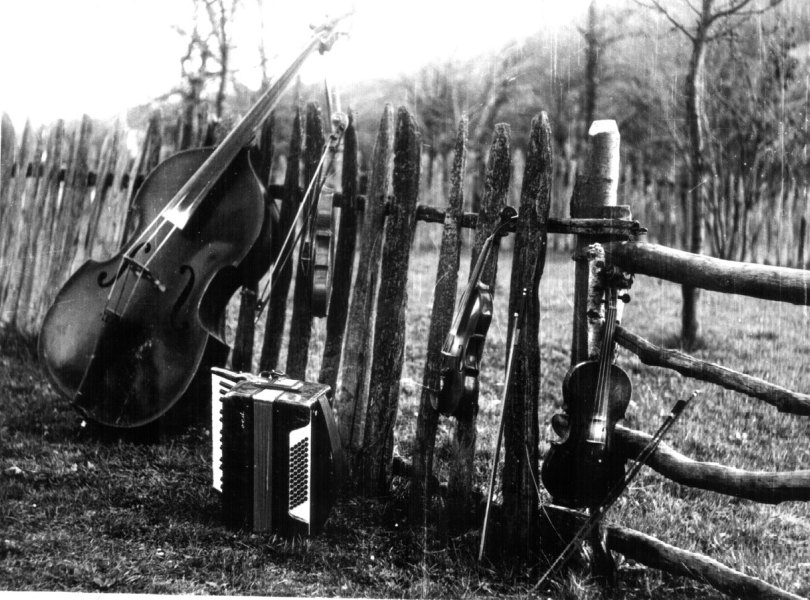
The instrumentation of the bands corresponds to the line-up usually known in the Zemplín and Šariš regions: two or three violinists, complemented by one or two three-string violas tuned G, D, A, a three-string double bass and a cimbalom. The accordion appeared occasionally. An interesting finding was the absence of the double bass in bands of the eastern half of the district, especially around today’s Domaša reservoir. It was replaced by a large bass drum with a cymbal (bands from Dobrá nad Ondavou, Benkovce, Rafajovce, etc.).
During fieldwork I gathered a great deal of musical material and old recordings of folk bands, mostly from the Šariš part of the district. The existence of recordings from this area may have been helped by the fact that local bands here worked with the newly founded folk ensembles, so there was more interest in recording music. In the Zemplín part, recordings of the original bands are lacking. The only exception is the band from Zámutov, which, thanks above all to PhDr. Ondrej Demo, was often researched and recorded; and similarly the band from Čaklov, recorded by Slovak Radio together with the local folk group in 1952.
From the recordings obtained it can be deduced that the violinists’ playing features various types of ornaments, from simpler turns and runs (Kura, Saukulič) to more complex melodic runs and ornaments (Horvát Jančár, Husák, Haluška). When several violinists play together there is no attempt to split into separate parts; they mainly play the same melodic line, each with different ornaments. An attempt to split the parts can be heard only in the band of Ernest Haluška from Hanušovce nad Topľou and in the band of primáš Juraj Husák when, for a time, Imrich Kura from Vyšný Žipov joined it as second violinist.
As mentioned several times, the Vranov nad Topľou district lies on the border of two counties, so we consider it appropriate to divide the documented bands into the Šariš and the Zemplín parts of the district.
Bands of the Šariš part of the district
The band of Ján Saukulič from Bystré
Ján Saukulič (*1921 – †2001) was born in Nižný Komárnik (Svidník district) but spent his whole childhood in Fričovce (Prešov district). His father and grandfather were Greek Catholic priests, so he too entered the church grammar school in Košice, where pupils had to learn an instrument. As his younger brother already played the violin and studied at a folk art school, Ján also chose the violin. After his studies he became a teacher in Lesíček and was later transferred to Demjata (Prešov district). He made his first steps as a musician and primáš in the Jánošík folk ensemble in Fričovce, which he helped to found.
In 1958 he took a job as secretary of the Cementár works club at the cement plant in Bystré (Vranov nad Topľou district). In 1960 he moved with his family to Bystré, where he took over the Cementár folk ensemble, previously led by Mrs Dziváková. From its beginnings Cementár had been accompanied by a Roma band with the excellent primáš Michal Dávid Tulo from Bystré. As an active musician, Ján Saukulič gradually joined the band and slowly became its leader, because he had an excellent memory for the tunes used in the ensemble’s choreographies and was the only one who could read music.
At that time the band had 5–6 musicians: two or three violinists – Ján Saukulič, Michal Dávid Tulo, Jozef Mitráš Šuko; three-string viola – Ján Sivák Bubňar; cimbalom – Jozef Mitráš Icik; and three-string double bass – Ján Mitráš Dančar. Even before Saukulič arrived, the band was known locally as the Mitrášovci. All its members came from Bystré. The band had a very good name far and wide, and since primáš Saukulič could read music, they could also help out several folk groups – they played, for example, for the folk society in Hermanovce and for the Bukovčan ensemble founded at the Bukóza plant in Hencovce near Vranov nad Topľou.
A notable feature of the band was its stable line-up over many years. Ján Saukulič was a great pedant and constantly made the band practise and improve. They were greatly honoured when the radio editor of the time, Ondrej Demo from Bratislava, chose them as the accompanying band for a competition of child singers in Žilina.
„ tam hraľi, ta prišol Tibor Andrašovan (hudobný skladateľ a dlhoročný riaditeľ SĽUKu) gu cimbalistoj Icikovi a śe pita: Vy máte aké hudobné vzdelanie? Ta žadne, ocec me naučil .“
“When they played there, Tibor Andrašovan (composer and long-time director of SĽUK) came up to Icik the cimbalom player and asked: ‘What musical training do you have?’ – ‘None, my father taught me to play.’”
Dušan Saukulič
A small change in the line-up came only in 1972, when the trade-union leadership at the cement works changed and the Cementár ensemble in Bystré partly ceased to exist. The band left Bystré for the Oblík ensemble in Hanušovce nad Topľou. In Oblík they played together with the excellent violinist Ján Husák Rabčák from Ďurďoš and the violinist Jozef Mitráš Šuko; violinist Michal Dávid Tulo played for Oblík only very rarely. The band played there for about two years. As an ensemble band they took part in many festivals in former Czechoslovakia (Východná, Strážnice, Raslavice, Svidník) and in various regional celebrations and competitions. In 1972 Oblík, accompanied by the band led by Ján Saukulič, won first place in the folk ensemble competition at Východná. The band also appeared in Slovak Television films: A na našim moscičku (1972), Deti spod Oblíka (1974), Traja pamätníci (1974).
„ me nahravaľi film A na našim moscičku, ta na začatku je tam prichod muziki. Parobci ňeśu cimbali a muzikanci idu pred ňima. A to tak dolu brižkom śe išlo. A jak me uš pri mosce, ta režiser zrazu skričel: Stop, odznova! No a mi hore brižkom a nazad dolu brižkom, cimbali na pľecoch. No a toto śe opakovalo 98 raz. Ocec uš nervoźňe s paľičku chodzil a kazal, že teraz nas stopňe, ta ho z totu palicu vižeňe stadzi .“
“When we were filming A na našim moscičku, at the beginning there’s the arrival of the band. The lads are carrying the cimbaloms and the musicians walk in front of them. And you went down a little slope. And when we were already by the bridge, the director suddenly shouted: ‘Stop, again!’ So we went back up the slope and then down again, with the cimbaloms on their shoulders all the time. And this was repeated 98 times. My father was already walking around nervously with his stick and saying that if he stopped us again, he’d chase him out of there with that stick.”
Dušan Saukulič
In 1974 the band returned to the revived Cementár ensemble in Bystré, now led by Anna Liptáková. Clarinettist Ján Bednár had by then joined the band.
Besides the folk ensembles, the musicians also found work at the Studničky motorest in Vranov nad Topľou and at the Gejzír hotel in Herľany, where they played regularly. Besides folk songs, their repertoire included songs and tunes from the popular music of the time and various international hits. After Ján Saukulič became primáš, they no longer played at village weddings or dances. Ján was an excellent manager and, even without village dances and weddings, he was able to create and find so many playing opportunities that his fellow musicians had no need to look for work elsewhere. The musicians’ satisfaction was surely helped by the fact that primáš Ján Saukulič always drove everyone in his own car and created the best conditions for his musicians.
„To hraľi na Studňičkoch, dze, a hraľi dluhši do noci, ta to muśela i večera, ocec vibavil.“
“When they played at Studničky or somewhere and played late into the night, there had to be dinner too – my father arranged everything.”
Dušan Saukulič
Photographs and film footage of primáš Ján Saukulič show his unusual way of holding the bow. This was caused by an injury suffered in the Second World War. As a driver of a military truck in 1944, on the Branisko mountain pass, he ran into German soldiers who opened fire and shot him through the right hand. Since then he had lost feeling and mobility in the hand, which forced him to change the way he held the bow.
His playing technique was not exceptional, and he was aware of it himself. Although he was the band’s primáš, Ján Saukulič often played in the lower positions and let his fellow violinists shine.
Ján Saukulič was very gifted and passionate about the arts. Besides leading the ensemble and playing actively, he completed a course for theatre directors and even worked and directed in the village theatre. He also founded a brass band in Bystré. He was a collector of folk songs too, going with his son Dušan to record local singers and musicians on his reel-to-reel tape recorder. After some time he moved to Vranov nad Topľou, where he worked as a taxi driver, and in 1984 he stopped playing actively in Cementár. With his departure the whole band ended its activity. Ján Saukulič died in 2001 in Vranov nad Topľou.
The Mitráš family band from Bystré
The oldest mention of this band is from 1955, when it played at the ceremonial opening of the cement works in Bystré. [4] It can therefore be counted among the post-war bands. It accompanied the Cementár folk ensemble from its founding until 1989. The primáš was Michal Dávid Tulo, a musician who stood out above all because of his height, but no less because of his musical talent.
„Tulo najľepši u Bistrim, sem tam i u Obliku zahral. To raz mal isc Oblik na dajake štatne vistupeňe a uš śe ňedalo odvolac. Ňemal kto z ňima isc jak , bo to trebalo pametac všeľijake prechodi, ta Tulo povedzel: Ja ňeidzem dokim mojomu sinovi ňepridzeľa bit. Ta taki vibiti. Ta joho sinoj pridzeľiľi bit a pošol hrac.“
“Tulo was the best primáš in Bystré; now and then he played for Oblík too. Once Oblík was supposed to go to some state performance and it couldn’t be cancelled. There was nobody to go with them as primáš, because you had to remember all the different transitions, so Tulo said: ‘I’m not going until they give my son a flat.’ That’s how smart he was. So then they gave his son a flat and he went to play.”
Ján Šarišský
Juraj Husák from Ďurďoš also spoke very highly of Tulo. He reportedly had a very good playing technique, as confirmed by the only available recording I managed to obtain. The band played at weddings and dances in the surrounding villages until Ján Saukulič joined it.
Tulo died in 1989 in Bystré. His band is described in more detail in the section on primáš Ján Saukulič.
The Baláž family band from Remeniny
The village of Remeniny was once important in terms of cultural life. It was among the first to build a culture house. There was a village theatre and also the folk ensemble Verchovina, founded in 1958 by the school head, Mr Duleba. The ensemble was successful and performed at festivals in Svidník, Východná and Giraltovce.
„A jak me hrac u Vichodnej, ta jak me zbačiľi, ta calkom cichota bula. Ja taki maľučki s totu basu, lem tak mi ju za cahal. A taki stolček mi mal a na stoločku tak mi hral. Aľe hral mi jak dospeli.“
“And when we played at Východná, as soon as they saw us, it went completely quiet. Me so tiny with that bass, I was only dragging it by the neck. And I had a little stool and I played standing on the stool. But I played like a grown-up.”
Ján Baláž
Their repertoire included songs and dances from around Hanušovce nad Topľou, such as the krucená, čardáš, ceperka, schadzana, šarišska poľka and others. The ensemble was accompanied by the Baláž band from Remeniny. This non-Roma family band was founded even before Verchovina. Its primáš and founder was Andrej Baláž (*1917), a forestry worker. He was a self-taught multi-instrumentalist who played violin, viola, double bass and accordion, and gradually taught his two sons to play. Andrej Jr. (*1934) played the three-string viola and the younger son Ján (*1944) the three-string double bass. The band was occasionally joined by the Roma musicians Berti and Mižak from Prosačov (violin, viola) and Šofranko (violin) from Remeniny. It was often joined by the singer Anna (*1942) – the musicians’ sister and daughter.
The band did not travel around to play; it played more or less only in the village and for the local Verchovina ensemble. They found playing occasions at village celebrations, feasts, May festivals, village dances and weddings.
„A tu bula u valaľe hoscina, ta chodziľi hrac i cigaňi z Hanušovec a chodziľi hrac z chiži do chiži. A muj ocec hutori śestre mojej: „Jak pujdu cigaňi hore valalom, ta mi poviš“. „Uš idu hore!“ a mi lapili hrac. Cigaňi śe zastaviľi, staľi pri kapurke, sluchaľi a pošľi daľej. Ta mi prestaľi hrac. „A davaj teras pozor jak pujdu nazad dolu“. „Uš idu!“ A mi lapiľi hrac. A cigaňi śe zastaviľi pri kapurke, sluchaju, sluchaju a jeden hutori: „Ta to toten gadžo muśi bohovski placic, tak dluho mu hraju.“
“And when there was a feast here in the village, Gypsies from Hanušovce came to play too, going from house to house. And my father says to my sister: ‘When the Gypsies come up through the village, tell me.’ – ‘They’re coming up!’ – and we started playing. The Gypsies stopped, stood by the gate, listened and then went on. So we stopped playing. ‘And now watch out for when they come back down.’ – ‘They’re coming!’ And we started playing again. And the Gypsies stopped by the gate again, listened and listened, and one says: ‘That gadžo (non-Roma) must be paying them a fortune, if they’ve been playing for him so long.’”
Ján Baláž
All the musicians sang as well as played, and their sister Anna even helped them with singing. The informant Ján Baláž had played in the band since the age of 12 and recalled his beginnings with a smile.
„Raz me hrac na veśeľu a mňe uš dluho , ta mi aš do plaču. Ta tamte uš chlopini a co ja taki chlopčik 13 ročni, a to trebalo calu noc hrac na basu. Voňi i vipiľi i a ja nič.“
“Once we were playing at a wedding and it had been going on so long that I was close to tears. The others were grown men, and I was just a 13-year-old boy, and I had to play the bass all night. They had drinks and everything, and I had nothing.”
Ján Baláž
Despite great efforts, no group photograph of the musicians and no recording of their playing could be found. At the Svidník and Východná festivals where the band performed, continuous film or sound recordings were not yet being made at that time.
With the death of primáš Andrej Baláž Sr. the band ended its activity, and music-making became only an occasional solo affair.
The band of Ján Husák Rabčák from Ďurďoš
Ján Husák Rabčák (*10 November 1920 – †3 July 1986) came from Ďurďoš, about 5 km from Hanušovce nad Topľou. He was born, together with his four siblings, into a family of musicians. His father, Ján Husák Sr., was a renowned primáš throughout the area. Naturally, it was his father who taught him the violin and took him to play at village weddings and dances while he was still small. His talent showed very early, and he gradually became a respected, excellent primáš far and wide around Hanušovce who had perfect command of the local repertoire. At about the same time the band of primáš Ján Horvát Jančar from Pavlovce was also active in the area, but they mainly went to play in a different direction, while the Hanušovce band of primáš Ernest Haluška played only at prominent weddings and dances. Ján Husák therefore had a great many playing opportunities in the area. He worked at the East Slovak Ironworks, where he went for week-long shifts, and played constantly at weekends.
„Ja z ňim chodzil i po veśeľoch, to mi taki mali chlapec a jemu gadžo išol rozkazac, ta lem gambu otvoril a uš hral. śpivanki , každeho po tich valaloch, chtora .“
“I went with him to weddings too, I was still just a little boy, and when a gadžo (non-Roma) went to order a song from him, he’d barely opened his mouth and he was already playing. He knew all the songs, he knew everyone in those villages, which song belonged to whom.”
Juraj Husák
The available records of the band under his leadership date only from 1973, when the Slovak Academy of Sciences (SAV) recorded dances from Petrovce and Hanušovce nad Topľou.2 The recording features the band led by Ján Husák Rabčák – primáš, Ján Sivák Bubňar from Bystré – three-string viola, and Zoltán Kiňa from Hanušovce – double bass. This line-up was certainly deliberately trimmed for the SAV recording, because they never went to play at weddings and village dances in such a small formation.
From the information gathered we know, however, that this “trio” always formed the core of the band, most often joined by violinist Juraj Husák from Ďurďoš and the cimbalom players Ján Mucha from Hanušovce, Dávid from Bystré or Ján Kukuš from Benkovce. Ján Husák Rabčák suffered a stroke and from then on had memory problems; he could no longer start songs himself or play as primáš. Because of his illness he also partly lost his hearing, which drastically affected the rest of his musical life. From that moment on he no longer had his own band.
„ ten Jančo znal šumňe hrac, uš ňič ňepametal. napriklad śi mu povedzel hraj Šarišsku poľku ta ňeznal co ma hrac. Aľe teľo co śi mu kus zahral, ta śe lapil.“
“That Jančo could play really beautifully, it’s just that afterwards he didn’t remember anything. For example, if you told him ‘play the Šariš polka’, he didn’t know what to play. But as soon as you played him a bit of it, he caught on straight away.”
Juraj Husák
Ján Husák Rabčák played actively for the Oblík ensemble from 1972, first joining the band led by Ján Saukulič and later the band of Juraj Husák. He also appeared in Slovak Television films: A na našim moscičku (1972) and Deti spod Oblíka (1974) as a member of Ján Saukulič’s band, and in the documentary Klenotnica ľudovej hudby and the film Šariš (1974) with the band led by Juraj Husák.
From the informants we know that Ján Husák Rabčák was an excellent and versatile violinist, a primáš with a brilliant violin technique and a broad command of the repertoire. Local bands often asked him to help out even after his illness, when he could no longer lead a band himself. This is also shown by his last audio and video recording, made during research into folk dances in Hanušovce nad Topľou in 1986 by Milan Hvižďák and Štefan Kocák. The recording features the Kura family band from Vyšný Žipov, which Ján Husák Rabčák joined later during the session. With his arrival the whole band changed character and its quality rose markedly, as Milan Hvižďák personally confirmed.
„To prišol tot stari Husak z Ďurďoša, ta to aš ftedi bula muzika.“
“When old Husák from Ďurďoš came along, only then was it a real band.”
Milan Hvižďák
Ján Husák Rabčák was a great lover of motorcycles, and this proved fatal. He died in 1986, aged 65, after riding home from a gig on his motorbike in cold weather. He developed meningitis, from which he died about three months later. He is buried in his native Ďurďoš.
The band of Juraj Husák from Ďurďoš
Juraj Husák (*8 November 1947 – †6 April 2022), or Ďura as everyone called him, was a very important person in my life as a musician. When in 2006, as an inexperienced 17-year-old, I joined the Bystrančan folk ensemble in Bystré, a Roma band under his leadership was still playing there. From Ďura I gradually learned the ensemble repertoire as well as the local song and dance repertoire of the Hanušovce area. He taught me to play “the old style”, for which I am immensely grateful. In 2015–2016 I carried out several research sessions with Juraj Husák, asking about his beginnings as a musician and his playing occasions, as well as about the bands active around Hanušovce nad Topľou. Juraj Husák was the last living primáš of the old generation in the Hanušovce area. The band he led, which began playing in the 1980s, was one of the more recent bands in the northern part of the district.
Juraj Husák came from the Husák family of musicians from Ďurďoš. He chose the violin following the example of his older brother Ernest, who also taught him to play. As an adult, Ernest moved to Bohemia, where he played in an orchestra.
„Brat me naučil hrac jednu calu peśňičku a z druhej me naučil polovicu. Totu som už muśel dokončic sam a ostatňe som śe uš naučil sam.“
“My brother taught me to play one whole song and half of another. I had to finish that one myself, and everything else I learned on my own.”
Juraj Husák
At first, as a young boy, he went with the musicians to weddings and dances to learn. His role models were his uncle Ján Husák Sr. and his cousin Ján Husák Rabčák, with whom he played in the band, and also Ján Horvát Jančar from Pavlovce – although he never played with Jančar, even though they knew each other personally. As a member of the band led by primáš Ján Husák Rabčák, Juraj Husák played not only at ensemble performances but at every possible occasion far and wide around Hanušovce nad Topľou. At first, as a young musician, he played the viola and slowly learned the trade.
„Ja calu noc pri muzikantoch prestal a sluchal, na druhi dzeň mi cvičil.“
“I stood by the musicians all night and listened, and the next day I practised.”
Juraj Husák
Weddings and village dances were their most frequent occasions. There they played without a cimbalom, because the musicians mostly travelled on foot.
„Najhorši to mal baśista, bo toto cahac pres ľesi mu treba.“
“The bass player had it worst, because he always had to drag that thing through the woods.”
Juraj Husák
Weddings took place on Saturdays and dances on Sundays. Since there were relatively few ways to enjoy oneself in the past, there was a dance every Sunday in a different village.
„Ta to , každu ňedzeľu. Mi uš aňi ňestačiľi teľo , co teľo toho .“
“It was all the time, every Sunday. We couldn’t keep up with playing so much, there was so much of it.”
Juraj Husák
This and other testimonies of several witnesses show the high quality and great popularity of this band with the majority population. Juraj’s musicianship, and his reputation, developed slowly. In 1973 Andrej Velčko, founder and leader of Oblík, asked him to help out at an ensemble performance. At that time the primáš of the ensemble’s band was Ján Husák Rabčák and Juraj helped out on viola. After his stroke, however, Ján Husák Rabčák had great problems starting songs and with the transitions between songs in the choreographies, and here Juraj Husák proved a suitable candidate for new primáš. He very quickly mastered the ensemble’s repertoire and took over as primáš. His band became fairly stable for several years. It had six members: Juraj Husák – primáš, Ján Husák Rabčák from Ďurďoš – violin, Ján Sivák Sr. Bubňar – first viola, Ján Sivák Jr. Matuška from Bystré – second viola, Ladislav Liga from Ďurďoš – double bass, Ján Kukuš from Benkovce – cimbalom.
„To tedi bula viborna , ja z ňich najslabši muzikant.“
“That was an excellent group back then; I was the weakest musician of them.”
Juraj Husák
He gradually improved, however, with the help of his cousin Ján Husák Rabčák and of Ján Bažo from Soľ, who joined the group for a time. This was in 1974, when Ondrej Demo, editor at Slovak Radio Bratislava, came to Hanušovce nad Topľou to record the programme “Klenotnica ľudovej hudby” (Treasury of Folk Music). Demo wanted to capture the Hanušovce dances performed by Oblík. Its leader Andrej Velčko wanted to present the ensemble in the best possible light, but at the time of the recording only one violinist was available – the young and inexperienced primáš Juraj Husák. Velčko remembered and approached the excellent violinist Ján Bažo, a nephew of Ján Horvát Jančar from Pavlovce, who had perfect command of the local repertoire. According to the available recordings, Bažo had an excellent variation technique, with an audible similarity to Jančár’s style. Ondrej Demo himself praised the band’s high quality and pure stylistic performance.
„To tak cifroval, me naučil śicke Pitrovske (obec Petrovce) melodije. Vlastne me naučil skoro śicko co som znal.“
“He ornamented it like that; he taught me all those Petrovce tunes. In fact he taught me almost everything I knew.”
Juraj Husák
The ensemble and band rehearsed every day and the musicians were driven there by car. Even bringing cimbalom player Ján Kukuš every day from Benkovce, 30 km away, was no problem. The band also appeared in the 1974 Slovak Television film Šariš.
After primáš Ján Husák Rabčák and first violist Ján Sivák Bubňar left the band because of their age, the band settled into a group of 4–5 musicians: primáš and violinist Juraj Husák, violist Ján Sivák Jr. Matuška from Bystré, double bass player Jozef Lacko from Hanušovce nad Topľou, and cimbalom player Ján Kukuš, later his son Koloman Kukuš Kalman – both from Benkovce. This line-up was occasionally joined by the second violinist Bartolomej Kura from Vyšný Žipov. In 1978, because of Andrej Velčko’s illness, Oblík’s leadership and artistic direction changed, and the musicians therefore left the ensemble. In 1995 they began playing as the band of the Cementár ensemble, today Bystrančan. Here, too, the band played quite steadily, but in 2004 violist Ján Sivák Jr. Matuška left for Bohemia and was replaced by Jozef Lacko Jr., the bass player’s son.
„Ja uš znal, že jak Matuška pujdze het, ta je z muziku koňec“
“I knew that once Matuška left, it would be the end of the band.”
Juraj Husák
Juraj Husák played in Bystrančan until 2007, when he stopped playing actively, and the whole band with him. After a heart attack, a stroke and severe diabetes, Juraj Husák died on 6 April 2022 at the age of 74 and is buried in his native Ďurďoš.
Bands from the village of Vlača
The village of Vlača lies 4 km north of Hanušovce nad Topľou. As early as 1958 this small village without a Roma population attracted researchers from the Slovak Academy of Sciences so much that they shot the short film Tance z obce Vlača (Dances from Vlača) here.3 Shortly afterwards a band formed here with primáš Štefan Pohlod. The four musicians were: Štefan Pohlod – primáš, Ján Fečo and Juraj Sirotský – viola, Andrej Fečo – double bass. In 1960 the band performed with singers at the festival in Svidník.
The band did not last long, but a younger group of musicians formed who played at weddings and dances in the area until the mid-1970s. As violist Juraj Sirotský recalled, the furthest they played was in Zubné near Snina and in Hermanovce (Prešov district). The younger line-up was Tomáš Novák (Babie) – primáš, Ján Fečo and Juraj Sirotský – viola, Andrej Fečo and Ján Lajčin (Kračúnovce) – double bass, Ján Bača (Železník) – clarinet.
Music played on classic folk instruments slowly disappeared with the arrival of modern instruments and a general change in musical taste, especially among young people. Primáš Novák and Juraj Sirotský later became members of the band that accompanied the Oblík ensemble from Hanušovce nad Topľou at its beginnings in 1967.
The last known line-up was: Ján Majer (Železník) – primáš, Juraj Sirotský – viola, Ján Lajčin and Andrej Fečo – double bass.
The Jančár family band from Pavlovce
The folk band (banda) of Ján Horvát – the Jančárovci, as the locals of Pavlovce called them – was a renowned Roma band in the northernmost part of the district. During fieldwork around Hanušovce nad Topľou many informants said it was an exceptional band. Information about them was rather hard to obtain, because the Jančárovci were active a long time ago – from the 1950s to the mid-1970s.
The band was founded and led by Ján Horvát Jančár, son of a blacksmith from Pavlovce. According to the information obtained, primáš Ján Horvát Jančár was self-taught and gradually taught all his sons to play. The band had five musicians, the father and four sons: two violinists (primáš Ján and his son Július), two violists (sons Ján Jr. and Vojtech) and a double bass (son Imrich). All the musicians were multi-instrumentalists who could play several instruments. Later, around 1960, the band was also joined by Dezider, the primáš’s grandson, who played rhythm violin (kontra).
The years of birth of the band members were traced in the village house register: Ján Horvát Jančár (*29 January 1899 – †27 May 1980), Július Horvát (*18 February 1930), Ján Horvát Jr. (*22 September 1921), Imrich Horvát (*22 September 1939), Vojtech Horvát (*27 April 1934), Dezider Horvát (*1941).
The book about Pavlovce briefly mentions the village’s Roma musicians: “In the past the Gypsies of Pavlovce were above all good blacksmiths and musicians. A well-known blacksmith between the wars was Jozef Horvát, father of the primáš of the Roma band known as Ján Horvát Jančar. There were two Gypsy bands here – Jančar’s and Beľačkar’s. They played at weddings, feasts, village dances and in the surrounding villages.”
The informant Mária Vargová from Pavlovce was the daughter of the local publican and remembered the Jančárovci coming to play at dances in the pub. She said that Jančár did not even take his violin home but left it in the pub, because he knew that he would be the only one to play there again.
„Jančarovci chodziľi po veśeľoch a zabavach a potom tu bula i tota druha banda Beľačkarovci a voňi tak poza stoli chodziľi hrac.“
“The Jančárovci went to weddings and dances, and then there was also that other band, the Beľačkarovci, and they just went round playing behind the tables.”
Mária Vargová
There was a great rivalry between these two bands and their supporters, as shown by an entry in the Pavlovce village chronicle: “On 21 May 1956, in the early morning hours, a big fight broke out among citizens of Gypsy origin. The Gypsy settlement split into two hostile camps. Members of the lower group demolished the houses of their rivals, led by Ján Horvát Jančar. They hacked doors, windows and everything in their way with axes. When the musicians from the upper end returned home, a huge fight broke out. As a result, Štefan Horvát had a broken arm and leg, Štefan Horvát Piška a broken head and concussion, and Ján Horvát Jančar also a fractured skull. Right after the fight, on 23 May, the Gypsy settlement was set on fire and the straw roofs of three houses burned down. The fights were repeated more often and both sides were arming themselves. The members of the National Security had a lot of work calming them down. They confiscated six automatic pistols, lead knuckles, pitchforks, axes, shepherd’s axes and hoes mounted on 2–3-metre handles. The Jančárovci had to move to Šarišské Lúky, where they also worked.”
The Jančár band also played for the Oblík ensemble from Hanušovce nad Topľou at its very beginnings, when the ensemble was still based in Petrovce; they were approached by its founder Andrej Velčko. The band most often found work in the villages towards Prešov – most often in Chmeľov, where primáš Ján Horvát Jančár was born, and in Medzianky, Lipníky, Vlača, Podhrabina and others.
„Hej, ja pametam, jak chodziľi i z basu pres ľes smerom tam na Ľipňiki.“
“Yes, I remember them walking with the bass through the woods towards Lipníky.”
Jozef Pankuch
They rarely went to play towards Hanušovce nad Topľou, since at that time there were 3–4 complete bands in Hanušovce alone, which often did not let village bands play in the town. In any case, the Jančárovci had no shortage of work elsewhere.
„Na mojim vešeľu (Vlača r. 1959) hral Jančar, to vešeľe doma u drevenici. Teľo co svadba začala, lapiľi hrac, parobci śpivaľi jeden na druhoho a uš idu śe bic. A muj muž išol za Jančarom a mu hutori: „Sluchaj tu, ja placim, ta nebudzeš tu žadne prebačene hrac“. No a uš po bitke.“
“At my wedding (Vlača, 1959) Jančar played; the wedding was at home in a wooden cottage. As soon as the wedding began and they started playing, the lads started singing insults at each other and were about to fight. And my husband went straight to Jančar and told him: ‘Listen here, I’m paying, so you won’t play any prebačena (requests) here.’ And that was the end of the fight.”
Mária Gáčová, rod.Hermanovská
The band’s great popularity can also be judged from another entry in the Pavlovce chronicle. Since the band was paid for every dance, wedding or other occasion it played, the chronicle’s record of how much cash primáš Ján Horvát Jančár had gives an idea of their quality and how busy they were: As a result of the currency reform of 1953, money was exchanged. 500 Kčs in the new currency was exchanged per person. Some citizens of Gypsy origin had saved a lot of money. For example Ján Horvát Jančar, although he always complained that he was badly off, brought over 250,000 Kčs to the exchange.
According to informants, the Jančárovci were always very polite, well-dressed musicians. Primáš Ján Horvát Jančár wore gold chains around his neck and was once “paid” in an unusual way: for playing he received a gold ring with the portrait of US President J. F. Kennedy. By pure chance, this ring ended up in the depository of the museum in Hanušovce nad Topľou.
The high quality of the Jančár band was also mentioned in the recollections of primáš Juraj Husák from Ďurďoš, who always spoke of them with great admiration and respect.
Leadership of the band gradually passed to his son Július Horvát, who led it for several years. It gradually fell apart, however, when the brothers Július and Vojtech left for Bohemia to work. After Július returned, they played together only rarely and then not at all.
„Ja pametam iśče jak , že chodziľi po valaľe . som rukoval na vojnu v roku 1968, ja uš mal muziku z Bistroho – Mitrašovcov, bo Jančarovci uš ftedi ňehraľi.“
“I remember them from when I was still a child, going round the village playing. When I went into the army in 1968, I already had a band from Bystré – the Mitrášovci – because by then the Jančárovci weren’t playing much any more.”
Jozef Pankuch
It is interesting that the reputation of good musicians spread far and wide even though there were no means of communication like today. This is shown by the testimony of one informant, who told of an event in Pavlovce in the 1990s. Musicians from Raslavice with their then primáš Štefan Žolták Čečo had been engaged to liven up an evening reception. On arriving, the primáš remarked:
„Joj, kebi stari Jančar iśče žil, ta nas bi tu ňigda ňebulo treba, tak jak znal cifrovac,ta to ňichto ňeznal.“
“Oh, if old Jančar were still alive, they’d never need us here – the way he could ornament, nobody else could.”
Štefan Žolták Čečo
Knowing that primáš Ján Horvát Jančár was born in Chmeľov and often went to play in that direction led me to visit that village too. The extensive Chmeľov chronicle contains several entries about the Horvát band, but by then the primáš mentioned is Ján’s son Július. This was probably because Ján, owing to his age, had by then partly limited his playing or played only as second violinist.
Entry 1:
On 29 December 1960 our village was visited by members of the Lúčnica ensemble from Bratislava, who enquired about songs from Chmeľov. Finally they also visited the settlement of the Gypsy citizens, where the local Gypsy band played them several songs and the Gypsy women danced old dances. After rehearsing, they came to the national school building together with Ján and Július Horvát, the kontra player and the primáš of the band. The following dances, performed by the two musicians, were recorded on tape: bašistovská, marhaňská, čerana, krucená, verbunk, čardáš, Šariš polka and others. The musicians were rewarded for their good performance.
Entry 2:
For a long time in Chmeľov, folk celebrations, weddings and other occasions have been enlivened by the Gypsy band whose members are the Horváts. The primáš is Július Horvát. The staff of Lúčnica also praised this band during their recordings.
Entry 3:
On 22 April 1961 Czechoslovak Radio broadcast a programme of songs and music called “Putujeme za pesničkou” (In Search of Songs), recorded directly in the village under the direction of Ondrej Demo, a radio staff member from Bratislava, with our local singers accompanied by the Gypsy band of Július Horvát.
It is quite interesting that the village chronicle describes the Horváts as a local band, although they came from Pavlovce. This was probably because the Horváts kept very strong family ties in Chmeľov. The musicality of the whole Horvát family is also shown by the fact that Ján Horvát Jančár’s sister, who married into Ruská Nová Ves (Prešov district), had a son, Gejza, an excellent kontra player.
„Gejza, to široko daľeko najľepši kontrista.“
“Gejza was the best kontra player far and wide.”
Juraj Sirotský ml.
Primáš Ján Horvát Jančár was buried in Pavlovce in 1980 together with his violin. Today none of the descendants of this musical family plays traditional folk instruments. It is a great pity that neither Slovak Radio nor the ethnologists, musicologists and staff of the local cultural centre of the time took a deeper interest in this phenomenal band and documented it in more detail. I believe that if more recordings of their playing existed, the Jančár playing style would be much sought after and today’s musicians would gladly present it.
The band of Andrej Čurlík from Petrovce
When Andrej Velčko founded the Oblík folk ensemble in Petrovce in 1967, he needed a band to accompany the dancers. As a passionate folklorist he knew the local musicians, so he approached non-Roma musicians whom he knew played folk instruments. The primáš of the first band to accompany Oblík at its very beginning was Andrej Čurlík.
Primáš Andrej Čurlík (*1924 – †31 May 1991) was a native of Petrovce. He came from a poor family, and his interest in folk music and playing an instrument met with little understanding. As the family lacked money, he made his first violin himself, with thicker threads serving as strings. He got his first real violin in an interesting way: as a young man, at a dance in Hanušovce nad Topľou, he witnessed a fight between Roma musicians in which one band member threw the primáš’s violin to the ground and stamped on it. Andrej later picked up the broken violin and glued it together at home. He taught himself to play and gradually became a good performer. His band had five musicians: Andrej Čurlík – primáš, Ján Kokinda – violin (a native of Bratislava assigned to Petrovce as a teacher), Tomáš Novák (Babie) – violin, Juraj Sirotský – viola and Andrej Fečo (Vlača) – double bass.
The band was not one of the traditional bands that played in the area at that time; it was rather a group put together for the needs of the folk ensemble. They did not play at weddings or village dances and never even gave a performance with Oblík – they only attended the ensemble’s rehearsals. The band did perform at the second Svidník folk festival, but under the banner of the agricultural cooperative from Remeniny. They stopped playing after two years in Oblík, when the ensemble moved to the town of Hanušovce nad Topľou: commuting to regular rehearsals in the town was no longer acceptable for them. The band therefore broke up, and primáš Andrej Čurlík never played again.
Juraj Sirotský (*6 May 1937 – †15 August 2024) was a multi-instrumentalist, but primarily a three-string viola player. He came from Vlača, 4 km from Hanušovce nad Topľou. He taught himself to play, and from the age of 17 he played in the band of Ján Majer from Železník (father of the well-known musician and singer, the late Ondrej Majer from Železník), and later in Andrej Čurlík’s band from Petrovce. With short breaks, Juraj Sirotský played at weddings and village dances until he was 70, with various bands that called on him to help out.
„ Joj, ta do nas chodziľi muzikanci z okoľici zabavic sebe s ocom,na hojscinu a tak.“
“Oh, all the musicians from around here used to come to our house to play with my father, for feasts and so on.”
Juraj Sirotský ml.
The band of Ernest Haluška from Hanušovce nad Topľou
In the second half of the 20th century there were about four bands active at the same time in the town of Hanušovce nad Topľou, but one was absolutely outstanding. According to informants, the band of primáš Ernest Erni Haluška was a household name not only in Hanušovce and the wider area, but throughout eastern Slovakia. It was active from before the Second World War until the 1970s. The Haluškas were descendants of Hungarian Roma musicians originally from Čečejovce (Košice-okolie district). Work brought them to Hanušovce when, in 1942, construction began on the Prešov – Strážske railway line and the associated viaducts above the town. At that time primáš Ernest Haluška (*1918) and his two brothers (viola and double bass players) came to Hanušovce, found wives and settled there. Interestingly, although they were brothers, each had a different surname (Haluška, Body, Daniel). Ernest Haluška’s band was very well known and respected and played only at prominent weddings, feasts and other events. It usually had five members: Ernest Haluška – primáš, Ladislav Lacko – second primáš/terc (harmony violin), Ján Haluška Body – viola, Ernest Haluška Jr./Ján Mucha – cimbalom, Štefan Horvát Dančo – double bass.
„To Erni bi ňezňis, prišol pred ňeho spoceni a začal mu tam roskazovac,co ma hrac.“
“Erni wouldn’t stand for somebody coming up to him all sweaty and starting to tell him what to play.”
Jozef Lacko st.
In the 1960s Ernest Haluška and his band were even invited to weddings and dances in Orava, Banská Bystrica, Zvolen, Rožňava and other Slovak towns. [1] In my interview with primáš Juraj Husák from Ďurďoš about the bands of the Hanušovce area, he also remembered Ernest Haluška.
„Najľepši s kapelu v našej okoľici Erni Haluška. taki paňski muzikant. ňechodzil valalske veśeľa aňi zabavi, take paňske. To aš gu koncu, už ňebulo panoch, ta začal i pre chudobnejšich ľudzi . Voňi maľi i cimbal i klarinet.“
“The best primáš with a band around here was Erni Haluška. He was a gentlemen’s musician. He didn’t go and play village weddings or dances, only for the gentry. Only towards the end, when there were no gentlemen any more, did he start playing for poorer people too. They had a cimbalom and a clarinet as well.”
Juraj Husák
Ernest could read music and was a multi-instrumentalist who also played the cimbalom. For a time he even helped out as cimbalom player in the band of Martin Marcin Žolták from Raslavice.
In 1956 a jazz group was formed at the Bystré cement works, and primáš Ernest Haluška joined it as violinist. [4] The archive recording of his band that I obtained reveals a very refined style of playing, diametrically different from all the other bands of the Hanušovce area whose recordings I have been able to hear.
„To bula ňedzeľa a Erni vicahnul huśľe a začal tak pre sebe , pridaľi śe i joho bratove na kontri a basu, ta to śe zbehľi ľudze i muzikanci z okoľici a išľi sluchac. To tak jak teras pridze dajaki znami spevak do Prešova, ta ľudze idu na ňoho popatrec, ta to i na Erniho tak chodzili.“
“When it was Sunday and Erni took out his violin and started playing just for himself, and then his brothers joined in on kontra and bass, people and musicians from around came running to listen. Just like now when some famous singer comes to Prešov and people go to see him – that’s how they went to see Erni.”
Jozef Lacko
As a pensioner Ernest Haluška moved to Prague, where he worked as a guard at a hotel. In the evenings he played in its restaurant, accompanied by a piano. Later his long-time fellow musician, second violinist Ladislav Lacko Sr., also moved to Prague and continued playing with him in the evenings at the hotel restaurant.
The band of Ladislav Lacko from Hanušovce nad Topľou
Primáš Ladislav Lacko Sr. (*1926) and his band were active in Hanušovce nad Topľou and the surrounding area from about the 1960s. They played at weddings and various other occasions, mainly in the town but also in nearby villages. This was not a classic village band; their repertoire often included international hits played for listening. The Lackos were a well-known family of musicians in Hanušovce. Ladislav learned to play from his father, also an excellent primáš. Ladislav Lacko’s band usually had 5–6 musicians: Ladislav Lacko Sr. – primáš, Jozef Horváth – viola (Ladislav’s in-law, father-in-law of Ladislav Jr.), Ladislav Lacko Jr. – guitar, viola, Jozef Lacko – double bass (the primáš’s brother), Ján Mucha – cimbalom. Occasionally, especially at weddings, they were joined by an accordion player who came all the way from Prešov.
Primáš Ladislav Lacko Sr. gradually also took his second son Jozef to gigs, who stood in either for his brother on guitar or for his uncle on double bass. Worth mentioning is Ladislav Lacko Jr., a multi-instrumentalist with absolute pitch. He could identify every sound exactly and was the “brain” behind the harmonic thinking of the whole band. He had to stop making music early because of a work accident in which he lost his left arm.
For a time the Lackos were the accompanying band of the Oblík ensemble, after it moved from Petrovce to Hanušovce nad Topľou. They played with it from 1969 to 1972, when they were replaced by the band led by Ján Saukulič. [6]
The band of Ján Kiňa from Hanušovce nad Topľou
Ján Kiňa was a Roma violinist and primáš from Hanušovce nad Topľou. His band consisted of second primáš Bartolomej Husák, his brother Zoltán Kiňa – double bass, and his brother Milan Kiňa – accordion. They played at smaller celebrations and weddings. Ján also often went alone with his violin to play at feasts and pre-wedding gatherings.
„Huśľe mal take, jak z tigra hlava.“
“He had a violin like a tiger’s head.”
Ján Šarišský
The band of Michal Horvát from Hanušovce nad Topľou
In the census sheets of 1930 I traced an even older band around primáš Michal Horvát (*1897). The records also list Ján Haluška (*1871) as the band’s second violinist. No further information could be found.
Bands of the Zemplín part of the district
The band from Čaklov
In 1952 the oldest folk ensemble in the Vranov district was founded at the Secondary Agricultural Technical School in Čaklov by Ing. Helena Vrbová. Among other programme items, the young and enthusiastic folklorists rehearsed the “Čaklov Wedding”, a recording of which is kept in the Slovak Radio archive in Bratislava. The ensemble performed at village and school events, at the Východná festival and elsewhere. After Mrs Vrbová, the ensemble was led by Božena Nováková. [3]
The ensemble was accompanied by a local Roma band of 5–6 musicians from the Kotľár and Kroka families, who were known far and wide. They played at almost every wedding, dance, May festival and other event in the village and beyond. Finding out the musicians’ names and other information about them was very difficult: none of the witnesses active in the folk movement in the 1950s could say anything more about the band. I managed to find the surnames and nicknames of only three members: Ján Jarka played the double bass, Ladislav Tancoš Fučo the viola and Imrich Tatár the cimbalom. In the 1970s all of them also played for a time in the Vranovčan folk ensemble in Vranov nad Topľou.
„To jomu žena porubala cimbal zo śekeru, bo śe jej ňeľubilo, že chodzi a vona sama doma.“
“His wife chopped up his cimbalom with an axe, because she didn’t like him always going off to play while she was alone at home.”
Juraj Husák
The band of Belomír Rigo from Čaklov
In the census sheets of the first population census of 1930 there appears a band led by Belomír Rigo from Čaklov. Its members were Belomír Rigo – primáš, Jozef Huňák, son of Ondrej Huňák (*1908) – viola, Jozef Huňák Jr. (*1913) – viola, Ján Huňák, son of Ondrej Huňák (*1906) – double bass, and Jozef Huňák Sr. (*1885) – cimbalom. The oldest witnesses remembered a band known locally as the Huňákovci, but nobody remembered primáš Belomír Rigo.
The census sheets also list the musicians Štefan Goroľ – primáš and Michal Tancoš as the double bass player of his band.
The Kura family band from Vyšný Žipov
The Roma band of the Kura family came from Vyšný Žipov and was one of the more recent cimbalom bands in the northern part of the district. It played actively from the 1970s. It had five musicians: Bartolomej Kura – primáš, Ján Kura Sr. – violin, Ján Kurečaj – viola, Ján Kura Komiňar – double bass, Imrich Kura – cimbalom. The group was occasionally joined by an accordion player, also called Kura, from the neighbouring village of Skrabské.
The violinists and the cimbalom player were related – they were brothers. Their father, Michal Kura (*1900), was also a musician who played with his band between the wars and after the war. They most often found work at weddings and village dances in the area. The Kuras were not among the famous bands, rather the average ones, but they still had plenty of opportunities to play. The informant Ján Šarišský said that the Kuras regularly played at the renowned dances at “mihalkovskich verškoch” (a farmstead above the village of Michalok), where dances lasted up to three days.
„Ja pametam, jak chodzili žipovske hudaci hrac do Ještrebja (Jastrabie nad Topľou) na hojscinu. perše prišľi do nas pozdravic moju mamu, ľebo bula rodačka z Vyšnoho Žipova. Muzikanci dobre znaľi, že mama ma na dvore nacahnute fajne izolovane oceľovo šnuri na višaňe vipratoho pradla. A voňi jej šnuri odrezaľi a zobraľi, maľi struni na basu. Toto śe opakovalo každi rok.“
“I remember the Žipov musicians coming to play at the feast in Ještrebie (Jastrabie nad Topľou). They always came first to our house to greet my mother, because she was a native of Vyšný Žipov. The musicians knew well that my mother had fine insulated steel lines stretched across the yard for hanging out the washing. And every time they cut those lines off and took them, so they’d have strings for the bass. This was repeated every year.”
Štefan Kocák
For a time (1989–1995) the band also played for the Cementár folk ensemble in Bystré. Primáš Bartolomej Kura also occasionally joined the band led by primáš Juraj Husák from Ďurďoš. The difference in the playing style of the two violinists was very audible, as Slovak Radio editor Milan Rendoš pointed out when Juraj Husák’s band recorded at Košice radio in 2001. In the end Milan Rendoš left Bartolomej Kura out of the recording to keep the pure playing style of Juraj Husák’s band.
Listening to the available recordings, it is clear that the band played more often in villages towards Vranov nad Topľou, because it knew a different repertoire from the one usually played around Hanušovce nad Topľou. An excellent example is the folk dance research carried out on 24 January 1986 in Hanušovce nad Topľou by the cultural workers and choreographers Milan Hvižďák and Štefan Kocák. The accompanying band for the singers and dancers was the Kuras from Vyšný Žipov. In the video one can see and hear the singer Michal Varga from Petrovce ordering several songs while the musicians have considerable trouble picking up the tunes. This is also a nice example of how the Upper Zemplín song repertoire overlaps with that of Lower Šariš in this area.
The band gradually fell apart as its individual members died.
The band of Jozef Feri Jusko from Zámutov
Primášes Jozef Feri Jusko and Jozef Kroka Češľak surely need no special introduction. They were the primášes of a unique folk band from Zámutov, which played in a fairly stable line-up for many decades.
The older of the two, Jozef Feri Jusko (*1 November 1907 – †1987), was leading the band in Zámutov as early as the late 1920s. It consisted of two violinists, a violist and a double bass player; for a long time the Zámutov band had no cimbalom. Jozef Feri Jusko came from Jastrabie nad Topľou, where he learned the trade from his father and played in the band of his uncle, Michal Ličartovský (*8 June 1889), primáš of the local folk band. Unfortunately, little is known about that band, and after primáš Ličartovský’s death no other band played in Jastrabie nad Topľou.
A tragic event deprived Jozef Feri of both parents while he was still a young boy, and he was taken into the care of his aunt Jusková in Zámutov – hence his nickname Jusko. In the 1930 census he was even recorded as Jozef Ferry. He founded his own band in Zámutov, which was later joined by the excellent, gifted young violinist Jozef Kroka Češľak.
Jozef Kroka Češľak (*23 March 1930 – †2013) was a native of Zámutov. He learned the violin from his uncle Jozef Feri Jusko. With Češľak’s arrival, Feri Jusko’s band gained its characteristic sound. Until Jusko’s death it played in a stable line-up: Jozef Feri Jusko – first primáš, Jozef Kroka Češľak – second primáš, Ján Feri (*1911 – †1975) – first viola, Juraj Ovšák Gubo (*1936 – †2004) – second viola, Ján Kotlár Kohucik (*1930 – †1996) – double bass. All members of the band were of Roma origin and related to one another.
The introduction of the band members during a recording at Czechoslovak Radio in 1973 was amusing. Introducing the first violist, Ján Feri, the editor Ondrej Demo asked him: “Your viola has three strings?”
Ján Feri: “Yes – one of them snapped on me.”
The band played at various social events in the village and far and wide, all the way to the Polish border. Their playing also impressed the committee at the auditions in Michalovce in 1962. In the autumn of 1963 Ondrej Demo, an editor of Czechoslovak Radio from Bratislava, came to Zámutov and invited them to perform with singers and dancers from Zámutov. Shortly afterwards they also appeared at the song and dance festivals in Východná and Strážnice and in the Czechoslovak Television programme Zem spieva. The band also appeared in the television films Zemplínska svadba (Zemplín Wedding, 1975) and Neplačte vy mamička (Don’t Cry, Mother, 1982) and in many other programmes devoted to traditional folk culture. Throughout its existence the band accompanied the local folk group Zámutovčan as well as the excellent dancer Juraj Šaffa from Dlhé Klčovo.
Jusko and Češľak were not subordinate to each other – both acted as primáš. Sometimes Jusko took the lead more, at other times Češľak. As in most of the bands studied in the Vranov district, each violinist played the leading part and varied it freely. And of course, as everywhere, there were occasional disagreements between them.
„Jusko vibiti. Jag me hraľi a jomu śe uš nechcelo ta povedzel, že ho hlava boľi a idze domu. pošol domu, vžal śicke peneži a nas neviplacil.“
“Jusko was very cunning. Once we were playing a wedding and he didn’t feel like playing any more, so he said he had a headache and was going home. He went home, took all the money and didn’t pay us.”
Jozef Kroka Češľak
Worth mentioning is the typical Zámutov rhythmic and harmonic accompaniment, played mainly by the two violists in full four-note chords. Violist Juraj Ovšák Gubo reportedly had an exceptional ear and could place every sound he heard on an exact pitch.
„ daco čul, ta lapal akord gu tomu.“
“Whenever he heard something, he straight away found a chord for it.”
Jozef Kroka Češľak
After Jozef Feri Jusko’s death, Češľak’s son Jozef Čonka joined the band, but he never reached his father’s level of playing. Češľak played for the folk group until his death (†2013) and became a model for many young primášes who are adopting his unique playing style. Although traditional folk music is no longer heard in Zámutov today, the legacy of this excellent band lives on in the playing of many folk bands across Slovakia.
The Mucha family band from Kamenná Poruba
The Muchas were a well-known family of musicians from Kamenná Poruba who for many decades played for and entertained people in the village and as far as the town of Vranov nad Topľou. My grandfather Michal Kertis (*1927) told me about this band when I was still studying at the art school.
„Budzeš ras tak , jak tot Mucha s Porubi“
“One day you’ll play like that Mucha from Poruba.”
Michal Kertis
According to him, it was a well-known group of musicians who were in demand in Vranov nad Topľou too. In gathering information about this family I was greatly helped by the field social worker Ms Uchaľová, who accompanied me to the Roma settlement, where we managed to trace the still living daughter, now over 90, of the double bass and kontra player Michal Mucha (*1910) from the oldest generation of musicians.
This family band consisted of five brothers: Bartolomej Mucha Turila – primáš, Jozef Mucha Biľak – violin, Štefan Mucha Štefiov – viola, Michal Mucha Bubar – double bass/viola, and Mucha Kaleja – clarinet. Several of the brothers played more than one instrument and took turns while playing. According to one informant, this line-up played until about 1961.
„Jak som rukoval gu vojsku v roku 1959, ta mi hral iśče stari Mucha z partiju, aľe jak som śe uš vracil, ta uš hraľi mladše.“
“When I went into the army in 1959, old Mucha and his group were still playing for me, but when I came back, the younger ones were already playing.”
Jozef Matij
Outside their native village the musicians most often went to play in Dávidov, Vechec, Sačurov, Cabov and Lomnica. The informant Jozef Matij remembered the wild dances in Cabov.
„To śe biľi a choč kedi śe i štriľalo.“
“They were always fighting, and sometimes there was even shooting.”
Jozef Matij
With their “playing territory” the Muchas often encroached on that of Jozef Feri Jusko’s band from Zámutov, so there was a certain rivalry between them.
The double bass player’s daughter told me a funny story connected with the death of the clarinettist Kaleja. After he died, the lads from the settlement agreed to steal the late man’s clarinet. At night they went knocking on the window of the house where Kaleja had lived, saying: “Give us the horn, give us the horn!” The widow, believing that Kaleja himself had come back from beyond the grave to ask for his clarinet, threw it out of the window – and so it ended up in the lads’ hands.
The older group was succeeded by a younger line-up of Poruba musicians, mostly their descendants: Michal Mucha Miko – primáš, Michal Mucha Midoľo – viola, Jozef Karchňák (*1929) – double bass, the violist’s brother, Emil Mucha Handov – cimbalom, Gejza Mucha Televizor – accordion. The younger group stopped playing in the 1970s, when modern instruments came into fashion and interest in traditional music declined.
The band of Jozef Vasiľ Miko from Sečovská Polianka
Sečovská Polianka is one of the larger villages of the district, and its land lies at the district’s southernmost tip. It could be said that the Upper Zemplín region ends at this village, and this is reflected in its traditional folk culture, where characteristic elements of Lower Zemplín can already be seen. In the 1960s a band led by Jozef Vasiľ Miko played here. This Roma band continued, with minor changes, until the 1990s.
The name of primáš Jozef Vasiľ Miko surely resonates with many people involved in traditional folk culture and active in folk ensembles and groups. He was a primáš, an all-round musician and an excellent dancer who often performed the well-known dance “Čiko čardáš” – a dance of a Roma musician with one or two women dancers from the majority population.
„Co Miko nezahral, to dotancoval.“
“What Miko didn’t play, he made up for in dancing.”
Jaroslav Balog
This dance is unusual, since in the past it was not customary for ethnic groups to mix at dances; rather, there was a hierarchy that did not tolerate such behaviour. According to informants, however, things were a little different in Sečovská Polianka. Relations between the majority and the Roma community were exceptionally good. It was nothing unusual for Roma families to be related to majority families (as godparents). The original Roma of Sečovská Polianka cannot even speak Romani; they all speak the Zemplín dialect. When I referred to them as Roma, informants even corrected me, saying that they were Gypsies (cigáni).
„Nehutor tak, že Róm, po romski. Ja som cigan, cigan som śe narodzil a i umrem.“
“Don’t say ‘Roma’ or ‘in Romani’. I’m a Gypsy – I was born a Gypsy and I’ll die one.”
Jozef Fedák
The band consisted of primáš Jozef Vasiľ Miko (*1927 – †2014) and three brothers: Jozef Tokár Oloveni (*1913) – cimbalom, Juraj Tokár Ďurak (*1915) – three-string viola, Andrej Tokár Andrijo (*1918) – double bass. Occasionally Michal Tokár from Vranov nad Topľou, a relative of the Tokár brothers, also played the cimbalom.
„Andrijo mal struni zos čerevoch na basu, sebe ich doma virabjal a veckaj ich skrucal a sušil na ploce.“
“Andrijo had gut strings on his bass; he made them himself at home and then twisted them and dried them on the fence.”
Jozef Fedák
Jozef Vasiľ Miko was originally from Veľké Ozorovce, and his wife came from Vojčice (Trebišov district). His father-in-law, nicknamed Mačanka, was a well-known musician in Vojčice, so Miko also had to play in his band, and in return his father-in-law sometimes helped out in Sečovská Polianka.
Primáš Miko did not come from a family of musicians, but as a teenage boy he rode his bicycle to Naciná Ves, where there were two excellent bands. He gradually picked up their playing style and learned the violin. His wife “Šarika” was also musically gifted – she played the cimbalom – but he did not take her along to play, saying that women did not belong in a band.
„Vona tak doma sebe bavila na cimbali, aľe ňimala paľički, ta z ložkami bavila.“
“Sometimes she played the cimbalom just for herself at home, but she didn’t have mallets, so she played with spoons.”
Milan Tokár
The band played actively in the village and the surrounding area, and often went to play in Strážske. They had no contact with other bands, and there was no standing in for one another. Roma musicians from neighbouring villages regarded them as “paňski” (gentlemen’s) musicians and wanted nothing to do with them – if they couldn’t speak Romani, they said, they weren’t Roma. Basically, the feeling was mutual.
„To maľi take dobre nastroje, že baviľi na jednim koncu , ta čuc aš na druhi koňec.“
“They had such good instruments that when they played at one end of the wedding, you could hear it at the other end.”
Milan Tokár
Later (in the 1980s) the band changed its line-up and primáš Miko played the viola. The primáš was Andrej Fedák Šandarik, and the double bass was played by the self-taught Godžar (Romani for “clever”), son of the former cimbalom player Jozef Tokár Oloveni.
„Godžar šedzel u karčme a bavil karti. Trebalo dakoho na basu, ta ho zavolaľi. Jak začal , ta śicke prestaľi špivac. Neznal , aľe veckaj śe naučil.“
“Godžar was sitting in the pub playing cards. They needed someone on bass, so they called him. When he started playing, everyone stopped singing. He couldn’t play, but then he learned.”
Jaroslav Balog
This newer line-up was formed mainly for the local folk group Bukovina. Primáš Andrej Fedák learned to play from primáš Ján Miškovič Pecek from Tovarné. Sadly, this line-up also ended its activity because of the musicians’ advanced age. In 1995, however, together with the folk group from Sečovská Polianka, they still managed to record the cassette “Kec v Poľance hraju” (When They Play in Polianka) with songs from the local group’s repertoire.
The bands from Čičava
According to witnesses, in the village of Čičava (about 4 km from Vranov nad Topľou) there were as many as two Roma bands: the first were the Jarka Židar family and the second the Husárik family. Information about them was very hard to obtain because the relatives did not know, or rather were unwilling to talk.
The Jarka Židar family band consisted of Jozef Jarka Židar – primáš, Bangač – three-string viola, Džuko – viola, Juraj Jarka (the primáš’s brother) – cimbalom, and later Emil Jarka Džuvalo (son of cimbalom player Juraj) – cimbalom. The witnesses’ accounts are rather unclear about the double bass: some claim there was none, others mention Ján Jarka Jantek (cimbalom player Juraj’s second son), who reportedly played the double bass.
„Toten kontrista Džuko hral aš jak stari Bangač umar. taki mali chlopik, kontri mal veľke a muśel mac na hlave čapku kontroval. Jak nemal čapku, ta neznal . Aľe cahal dobre.“
“That kontra player Džuko only played after old Bangač died. He was a small fellow with a big viola, and he always had to have a cap on his head when he played kontra. Without the cap he couldn’t play. But he bowed well.”
Koloman Kukuš
An interesting member of the band was the cimbalom player Emil Jarka Džuvalo, whom several witnesses described as a very talented musician. He died very young, however, at only 36. Džuvalo was the brother-in-law of the cimbalom player Koloman Kukuš from Benkovce, who after his death often took over as cimbalom player in the Čičava band.
„Voni chodziľi hrac aš tu na Domašu. Bo to dakedy išľi čardaše a čičavske cigani znaľi hrac tak mažľivo, tak zacahovaľi a ľudzom śe ľubilo ta ich volaľi kadzi tadzi. Bo to voňi češko robili, paľce maľi hrube ta voni tak scahovaľi. dobre hraľi.“
“They went to play as far as Domaša. Because back then it was all those čardášes, and those Čičava Gypsies could play so smoothly, with such drag in the bow, and people liked it, so they invited them here and there. Because they played heavily – they had thick fingers and pulled the bow like that. They played really well.”
Koloman Kukuš
The band of Ján Miškovič from Tovarné
In the 1950s and 1960s a band led by primáš Ján Miškovič (*1899) was active in Tovarné, playing for the social life of the village and its surroundings. There is little information about this group, but I found two entries in the village chronicle that mention it.
Entry 1: To show that they can not only work conscientiously and fulfil their tasks but also enjoy themselves together, the citizens and cooperative members organised a joint New Year’s Eve party. The organiser was the Czechoslovak Fire Protection Union. In a cheerful mood and to the music of J. Miškovič, our citizens spent the last day of the year together. (1960)
Entry 2: The cooperative members bought musical instruments for 12,000 Kčs so that they would not have to hire outside musicians for dances, and so the young cooperative members Štefan Durkaj, Bart. Konečný, Jozef Špirňák, Jar. Kucík and Ján Miškovič, led by Bart. Feri, began rehearsing. This band first played on 8 August at the harvest festival. (1964)
Ján Miškovič’s band most often played in this line-up: Ján Miškovič Pecek – primáš, Bartolomej Feri – violin, Michal Miškovič – rhythm violin (kontra), Aladár Beňak – saxophone, Vojtech Feri Bejla – cimbalom, Ján Miškovič Jr. – drum.
„Bejla, to chlop jak obor. nabral šena na vidli, ta še ci vidzelo, že idze cali vuz.“
“Bejla was a giant of a man. When he picked up hay on a pitchfork, it looked like a whole cartload was moving.”
Koloman Kukuš
They most often went to play towards Humenné, in the villages of Topoľovka and Hudcovce, at most as far as Benkovce, where another band was already active.
The band of Ján Kukuš from Benkovce
In Benkovce the Kukuš family of musicians had a long tradition spanning several generations. A well-known and popular primáš was Ján Kukuš (*1920), who played with his band. He was a multi-instrumentalist who, besides the violin, also played the cimbalom. As a young man he started out as cimbalom player in the band of his father, Ján Feri Kalman, and later became an excellent primáš. Since there were very few cimbalom players in the area, Ján also travelled far and wide as a guest in other bands. For a time he also played in the Oblík ensemble from Hanušovce nad Topľou with Ján and Juraj Husák.
The band most often played in this line-up: Ján Kukuš – primáš, Jozef Ignác Židov from Žalobín – second primáš (Ján Kukuš’s brother-in-law), Jozef Ignác Naco – double bass (the second primáš’s father), Jozef Feri Kalman – viola (Ján Kukuš’s father-in-law), Ján Ignác Poľak – drum, and Vojtech Feri Bejla from Žalobín and Koloman Kukuš Kalman (primáš Ján’s son) – cimbalom.
„Voňi Ignacovo, aľe mi ich volaľi Nacovo. Ras pametam, že nas jednac na a mi sebe medži sobu tak hutorime: Ta na huśľe budze ten, ja na cimbal a na basu Naco. A gadžo nam hutori: „Čekajce, čekajce, ta jak naco, šak na basu muśi .“
“Their name was Ignác, but we called them Nacovo. Once, I remember, we were being booked for a wedding and we were saying among ourselves: ‘So on violin it’ll be him, me on cimbalom and on bass Naco.’ And the gadžo says to us: ‘Wait, wait – what do you mean “na co” (what for)? There has to be somebody on bass!’”
Koloman Kukuš
Playing regularly at weddings, dances and other social occasions had a positive effect on the musicians’ level of playing. Cimbalom player Koloman Kukuš played at weddings in his father’s band from the age of 10.
„Mi ešči aňi obed nežedľi a Kvakovčani uš stali s traktorom i z vľečku na dvore a uš braľi cimbali a išľi sme na zabavu hrac.“
“We hadn’t even had lunch yet and the people from Kvakovce were already standing in the yard with a tractor and trailer, already taking the cimbaloms, and off we went to play at a dance.”
Koloman Kukuš
The departure of the Ignác family to Bohemia for work led to the gradual break-up of the band. Today nobody in the Kukuš family plays a musical instrument.
That the Kukuš family has a musical tradition going back several generations is also confirmed by the fact that around the turn of the century a band led by primáš Jozef Feri Kalman (grandfather of cimbalom player Koloman Kukuš) was active in Benkovce and the surrounding area. For a while, as long as his health allowed, Jozef Feri Kalman also played in a line-up with his son-in-law Ján Kukuš.
Jozef Feri Kalman was a soldier in the Austro-Hungarian army, where he played for military purposes. After leaving the army and returning home he worked as a blacksmith, and he continued playing at home in Benkovce. The busiest season for musicians was from autumn to the end of Carnival, since work in the fields gradually stopped and most weddings in those years took place in winter. For this period Jozef regularly invited musicians from Hungary, friends from his army days, who stayed and lived with him for the whole season.
„ v žime chodzili muziki hrac pre panoch do kaštiľa. Pret kaštiľ prišli chočjake muziki z okoľici, zahraľi, a pan sebe vibiral, chtoru sebe vežňe. To prišol s tima maďarikami, ostatňe uš nemaľi šancu. Voňi znali tak maďarski, tak šumňe.“
“Every winter bands went to play for the gentry at the manor house. All sorts of bands from the area came in front of the manor, played, and the lord chose which one he’d take. When grandad came with those Hungarians, the others didn’t stand a chance. They could play so Hungarian-style, so very beautifully.”
Koloman Kukuš
The Tomáš family band from Dobrá nad Ondavou
Dobrá nad Ondavou was one of six villages that disappeared because of the construction of the Domaša reservoir. Until its demise in 1965 it was a central village with over a thousand inhabitants, a sawmill, a mill and a notary, and a doctor lived there too. It was also a cultural centre for villages from the wider area. For many years the local Roma band of the Tomáš Šuľak family played here, led by the excellent primáš Michal Tomáš (*1898).
This band was already active in the area after the First World War, but its line-up changed. In the parish registers I found a record only of the cimbalom player Imrich Kakáš (*1899), a member of the original line-up led by Michal Tomáš.
Later the band continued as a family group. It consisted of old primáš Michal Tomáš (sitting on the chair), his five sons – Michal Tomáš Jr. Piľo – second primáš, Ján Tomáš Šivi – saxophone, Tomáš Gusti – cimbalom, Emil Tomáš – accordion, Tomáš Sudruh (son of Michal Tomáš Piľo) – drum – and the violist Kotľár Churi, who also came from Dobrá nad Ondavou but was not a family member.
„Mac jim chodzila po valaloch vibavovac zakaski. Dze znala že budze vešeľe, ta uš ponukala, vijednavala.“
“Their mother went round the villages arranging gigs for them. Wherever she knew there would be a wedding, she was already offering, negotiating.”
Koloman Kukuš
Accordionist Emil Tomáš was the only one who had attended a music school and could read music. There was one more brother in the family, but he did not take up the musician’s trade.
„To take šumne chlopi , babi śe na nich lakomiľi. Fešaci, žulte vlasi maľi.“
“They were such handsome men, the women really fancied them. Dashing, with fair hair.”
Koloman Kukuš
The band was renowned and very popular in the whole area and played at various social events. For a long time it had no double bass; it was replaced by a drum with a cymbal.
„ chodzili hrac, ta i na tri dňi išľi, i spaľi tam. To sebe ich gadžove trimaľi.“
“When they went to play, sometimes they went for three days and slept there too. The gadže (non-Roma) really looked after them.”
Koloman Kukuš
The old primáš’s son Michal Tomáš Piľo gradually took over the band, but when the construction of the reservoir and the forced resettlement of the inhabitants were announced, all members of the family moved to Vranov nad Topľou. There their activity was ended by a tragic event when primáš Piľo drowned in the Topľa river. The remaining members later moved to Bohemia and the band ended its activity.
„To voňi še pre peňeži vadzili, na korune bi śe pobiľi.“
“They quarrelled a lot over money – they’d have fought over a single crown.”
Koloman Kukuš
In the 1960s a second, younger group of musicians was active in Dobrá nad Ondavou alongside the Tomášes. It consisted of two brothers, Jozef Čonka – saxophone and František Čonka – drums, Jozef Huňak Charňov – accordion, and Jusko Turko – primáš. They did not compete with each other; this group went to play rather towards Stropkov and as far as Svidník.
„Voňi chodziľi hrac aš tam na Valkov gu Stropkovu, prišľi po ňich na loďkoj a po Ondave išľi tam i nazad.“
“They went to play as far as Valkov near Stropkov – people came for them in a boat and they went there and back along the Ondava.”
Ján Čonka
After moving to Vranov nad Topľou, the Čonka brothers played for a while at weddings and dances around Vranov, joined by the Miľo brothers from Čemerné (cimbalom, accordion and primáš).
The band of Michal Michalov from Rafajovce
Rafajovce is a small village of about 150 inhabitants in the north-eastern tip of the Vranov district, inhabited mostly by an original Rusyn population. In the 1950s and 1960s the non-Roma Rusyn band of the Michalov brothers was active here. This band of four brothers entertained the local people at various social events. The inspiration for founding their own band was the non-Roma band of Ján Rakar in Nižná Sitnica, where accordionist Pavol Michalov often helped out and where he learned to play.
Pavol persuaded his brother Michal to found their own band. It was led by the eldest brother, Michal Michalov (*1924) – primáš, with Štefan Fedor – second violin, Pavol Michalov – accordion, Mikuláš Michalov (*1948) – cimbalom, Jozef Michalov – saxophone, Ján Daňko – viola (a Roma man from Rafajovce) and Ján Fedor – drum.
The youngest brother, Mikuláš, joined the band last, after they bought a cimbalom from the Tomáš Šuľak musicians from Dobrá nad Ondavou. Primáš Michal bought the cimbalom in a dilapidated state but managed to restore it. They started practising, playing and improving, learning by watching the Šuľaks themselves at weddings and dances.
There was great interest in the Michalovs. They were a non-Roma band and all of them sang while playing, which heightened the overall impression of their music. Although, as cimbalom player Mikuláš himself said, they were only half as good as the Šuľaks, the majority population preferred to hire them. This partly made enemies of the musicians from Dobrá nad Ondavou who had sold them the cimbalom, and who subsequently often confronted them.
„Mišku, ja kebi znal, že ti mi kšefti pokradneš, ta voľel mi rači cimbali u pecku popaľic, bi še aspoň mojo vnučata pri ňim zohraľi.“
“Miško, if I’d known you’d steal my gigs, I’d rather have burned the cimbalom in the stove – at least my grandchildren would have warmed themselves by it.”
slová primáša Michala Tomáša Šuľaka z Dobrej nad Ondavou
They most often played at weddings and dances in Holčíkovce, Giglovce, Piskorovce, Tokajík and further towards Stropkov.
„Na zabavu jag me išľi , ta brat robil na družstve, vžal vetresku (nákladné auto Praga V3S), pristavil tam, dze bula zabava, spuśčiľi me dolu bočnicu, cimbali hore, a tak me hraľi na korbe.“
“When we went to play at a dance, my brother, who worked at the cooperative, took the vetreska (a Praga V3S truck), parked it where the dance was, we let down the side panel, put the cimbalom up and played on the truck bed.”
Mikuláš Michalov
The youngest brother, cimbalom player Mikuláš, joined the band at the age of 12. Demanding night-time playing also showed in his school attendance and concentration at school.
„Najvecej śe hňevaľi učiteľki, bo me vidzeľi po zabavoch a svadboch, a veckaj som nebul naučeni a choč kedi mi i na lavici zaspal. Aľe dajak mi prebačiľi.“
“The teachers were angriest, because they saw me at dances and weddings, and then I hadn’t done my homework and sometimes I even fell asleep at my desk. But somehow they forgave me.”
Mikuláš Michalov
The band stopped playing in 1968, when the youngest brother Mikuláš returned from military service, mainly because of the arrival of modern instruments and the general change in people’s taste. The depository of the Slovak National Museum – Music Museum in Bratislava holds three artefacts by Michal Michalov from Rafajovce: a church rattle, a nativity staff and a bark trumpet.
Conclusion
The aim of this documentary research was to capture cultural and social life in the Vranov district in the second half of the 20th century. Above all, I wanted to introduce to the wider public the people who, with their passion, sought to preserve and develop the precious jewels of our traditional folk music culture.
I am grateful for the valuable information from the informants, for the cooperation of the institutions I approached, and for the positive response that has accompanied this research from the very beginning. It is said that “the spoken word perishes, the written word endures”. Although I am aware that much information has been lost forever, I know that thanks to this research a great deal has also been saved. It will remain written down and available to everyone who wants to learn more about the personalities of musical culture in the Vranov nad Topľou district.
For professional cooperation I thank Mr Štefan Kocák, Mgr. Peter Obuch, PhD., and Ing. Ján Čarnogurský. Many thanks also go to the Slovak Arts Council (Fond na podporu umenia), which supported the research in the Šariš part of the district in 2024–2025, and to the Fund for the Support of the Culture of National Minorities (Kult Minor), which supported the research in the Zemplín part of the district in 2026.